
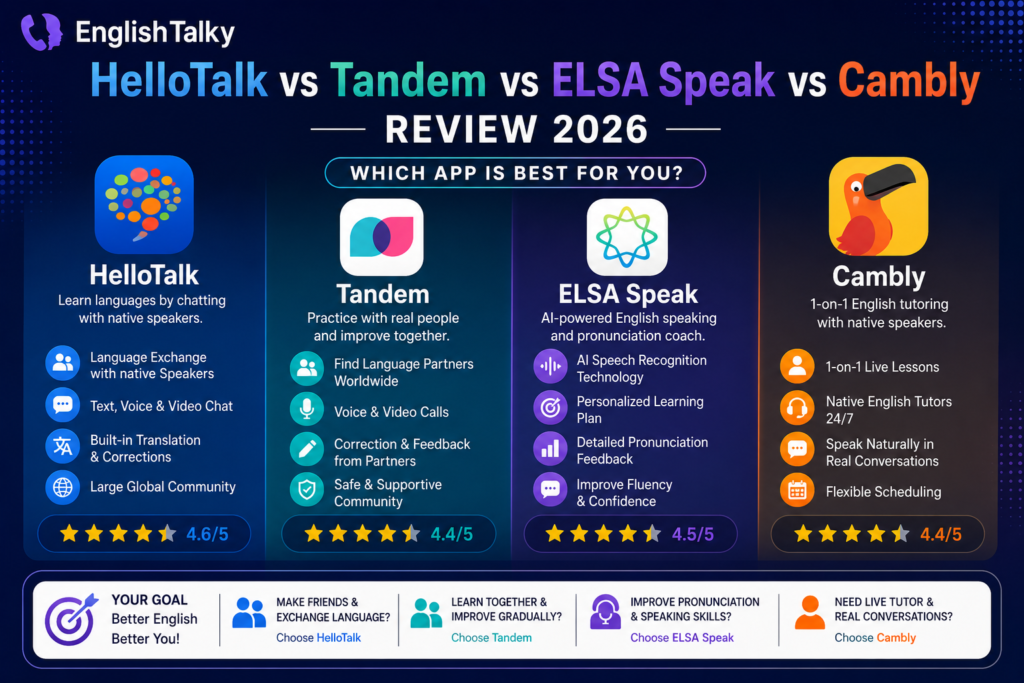
If you search for “practice English speaking,” you’ll quickly run into the same four names: HelloTalk, Tandem, ELSA Speak, and Cambly.
They dominate search results, YouTube reviews, and app store rankings for a reason. Each one has built a strong reputation by solving a specific part of the English learning problem—whether it’s finding people to talk to, improving pronunciation, or getting access to native speakers.
If you dig a little deeper, you’ll notice something interesting: most learners don’t just try one of these apps—they try all of them at different stages. That’s because no single platform fully replaces the others. One might help you start speaking, another might refine your accent, and another might give you the confidence to handle real conversations.
So when you see these four names everywhere, it’s not just hype. It’s a reflection of how fragmented English learning still is in 2026—and why choosing the right tool depends less on popularity and more on what you personally need right now.
The Big Picture: Four Apps, Four Philosophies
Before going deep, here’s the reality most people miss:
- HelloTalk → social networking for language exchange
- Tandem → structured language partner matching
- ELSA Speak → AI-driven pronunciation training
- Cambly → paid 1-on-1 English tutors
They’re not direct substitutes. They solve different parts of the same problem.
If your goal is fluency, you may even need more than one.
HelloTalk: The Social Media of Language Learning
HelloTalk is basically Instagram + WhatsApp, but for language learners.
You create a profile, choose your target language, and start interacting with native speakers. You can post “Moments” (like social posts), chat with people, and even correct each other’s messages.
What works well
HelloTalk’s biggest strength is volume. There are millions of users, especially from countries like China, Japan, Korea, and Latin America. That means you’ll always find someone online.
The correction tools are surprisingly useful. When someone edits your sentence, you see exactly what was wrong. Over time, this builds natural grammar awareness.
It also feels low-pressure. You’re not in a “class.” You’re just chatting.
Where it struggles
The same thing that makes HelloTalk fun also makes it messy.
Many users aren’t serious about learning. Some are there for casual chatting, some for socializing, and yes—some for flirting. If you’re focused, this can become a distraction.
Another issue is inconsistency. You might have a great conversation today and get ghosted tomorrow.
Voice practice is limited unless you actively push for it.
Who should use HelloTalk
- Beginners who want exposure to real English
- People who enjoy social apps
- Learners who don’t mind randomness
Who should avoid it
- Anyone who needs structured learning
- People who get distracted easily
- Users looking only for serious speaking practice
Tandem: A More Serious Language Exchange
Tandem tries to fix HelloTalk’s chaos.
It’s still a language exchange app, but with better matching and more control over who you talk to.
What works well
Tandem has stronger filtering. You can choose partners based on interests, goals, and availability. This leads to higher-quality conversations.
The community is generally more serious. You’re less likely to run into spam or casual users.
Voice and video calls are smoother compared to HelloTalk, making it better for actual speaking practice.
Where it struggles
Even with better matching, it still depends on other people.
If your partner is busy, slow, or loses interest, your progress slows too.
Also, you need to “give” as much as you “get.” If you’re not interested in helping others learn your language, the system doesn’t work well.
Who should use Tandem
- Intermediate learners who want real conversations
- People who prefer fewer but deeper interactions
- Users who are serious about consistency
Who should avoid it
- Absolute beginners
- People who don’t want to teach their own language
- Anyone expecting instant results
ELSA Speak: The AI Coach That Fixes Your Pronunciation
ELSA Speak is completely different.
There are no humans here. Just AI analyzing how you speak.
What works well
ELSA’s strength is precision.
It listens to your pronunciation and tells you exactly what you’re doing wrong—down to individual sounds.
For example, it can tell the difference between:
- “ship” vs “sheep”
- “bat” vs “bad”
That level of feedback is something even many teachers don’t consistently provide.
It’s also structured. You follow lessons, track progress, and see improvement clearly.
Where it struggles
ELSA doesn’t teach conversation.
You might sound perfect when reading a sentence, but still struggle to speak naturally in real life.
Also, it can feel repetitive. You’re practicing sounds and sentences—not real communication.
Who should use ELSA Speak
- Beginners who struggle with pronunciation
- Learners with strong grammar but unclear speech
- People preparing for interviews or presentations
Who should avoid it
- Anyone looking for real conversations
- Users who get bored with repetitive practice
Cambly: Real Tutors, Real Conversations
Cambly is the most direct solution: you pay and talk to native English speakers.
What works well
You get instant access to tutors from countries like the US, UK, and Canada.
No waiting, no matching issues. You open the app and start speaking.
This is the closest thing to immersion without traveling abroad.
Tutors can also adapt to your needs:
- casual conversation
- interview preparation
- business English
- exam practice
Where it struggles
Cost is the biggest barrier.
Regular practice can become expensive, especially for students in countries like India.
Also, tutor quality varies. Some are excellent teachers; others are just conversation partners.
Who should use Cambly
- Professionals who need fast improvement
- Learners preparing for interviews or exams
- People who prefer structured speaking sessions
Who should avoid it
- Budget-conscious learners
- Beginners who aren’t ready to speak yet
2026 Reality Check: What Actually Works?
Here’s the honest truth:
No single app will make you fluent.
Each one solves a different part of the speaking problem:
- HelloTalk → exposure to real, everyday English
- Tandem → actual back-and-forth conversations
- ELSA Speak → fixing how you sound
- Cambly → guided, structured speaking
Fluency isn’t one skill. It’s a combination of understanding, responding, sounding clear, and staying confident under pressure. These apps don’t compete—they cover different gaps.
For example, you might understand everything on HelloTalk but struggle to reply quickly. Tandem helps with that. Then you realize people still ask you to repeat—that’s where ELSA comes in. And if you want someone to correct you in real time and push you forward, Cambly fills that role.
The real question isn’t “Which app is best?”
It’s: “Which gap do I need to fix right now—and what should I use next?”
That’s how people actually become fluent in 2026: not by depending on one tool, but by using the right tool at the right stage.
Best Combinations (Based on Your Goal)
If you’re a beginner
Start with ELSA Speak to fix pronunciation.
Then slowly move to HelloTalk for basic chats.
Jumping directly into conversations without clear pronunciation often leads to frustration.
If you’re intermediate
Use Tandem for consistent speaking practice.
Add ELSA for refinement.
This combination balances real conversation with technical improvement.
If you need fast results
Use Cambly regularly.
Supplement with ELSA for accuracy.
This is the fastest path—but also the most expensive.
If you’re on a budget
Combine HelloTalk + Tandem.
Be prepared to filter people and stay disciplined.
You’ll invest time instead of money.
The Hidden Problem with All Four Apps
There’s one issue none of these apps fully solve:
Consistency.
- HelloTalk → people disappear
- Tandem → partners lose interest
- ELSA → gets boring
- Cambly → becomes expensive
This is why many learners start strong and quit.
Fluency doesn’t come from tools. It comes from daily speaking.
What to Look for in 2026 (Before Choosing Any App)
Instead of asking “which app is best,” ask:
- Will I use this every day?
- Does it force me to speak, not just listen?
- Can I stay consistent for 3 months?
If the answer is no, the app doesn’t matter.
Final Verdict
Each platform has a clear role:
- HelloTalk is great for casual exposure but lacks focus
- Tandem offers better conversations but still depends on people
- ELSA Speak is excellent for pronunciation but not fluency
- Cambly gives real speaking practice but costs money
If you choose only one:
- For free learning → Tandem
- For pronunciation → ELSA Speak
- For fast speaking → Cambly
But the smartest approach is combining them based on your stage.
A Practical Weekly Plan (That Actually Works)
Here’s a simple system you can follow:
- 15 minutes daily → ELSA Speak
- 20–30 minutes → Tandem or HelloTalk chatting
- 2–3 times a week → Cambly session (if budget allows)
Stick to this for 8–12 weeks, and you’ll see real progress.
Final Thought
Most people don’t fail because they chose the wrong app.
They fail because they don’t speak enough.
It’s easy to feel productive—scrolling through chats on HelloTalk, replying to messages on Tandem, completing lessons on ELSA Speak, or booking sessions on Cambly.
But none of that guarantees progress unless you actually speak.
Fluency is a muscle. If you don’t use it, it doesn’t grow.
You don’t need perfect grammar or accent to begin. What matters is repetition—speaking out loud, making mistakes, correcting them, and showing up again the next day. That’s where real improvement happens.
Even 10–15 minutes of daily speaking beats hours of passive learning. The gap between learners who improve and those who stay stuck usually comes down to one thing: consistency.
So whatever platform you choose—whether it’s HelloTalk, Tandem, ELSA Speak, Cambly, or something like English Talky — judge it by one simple standard:
Does it make you speak regularly?
If yes, stick with it. If not, change your approach.
Because in the end, the only feature that truly matters isn’t AI, matching algorithms, or native tutors.
It’s whether you open your mouth and use English—every single day.