
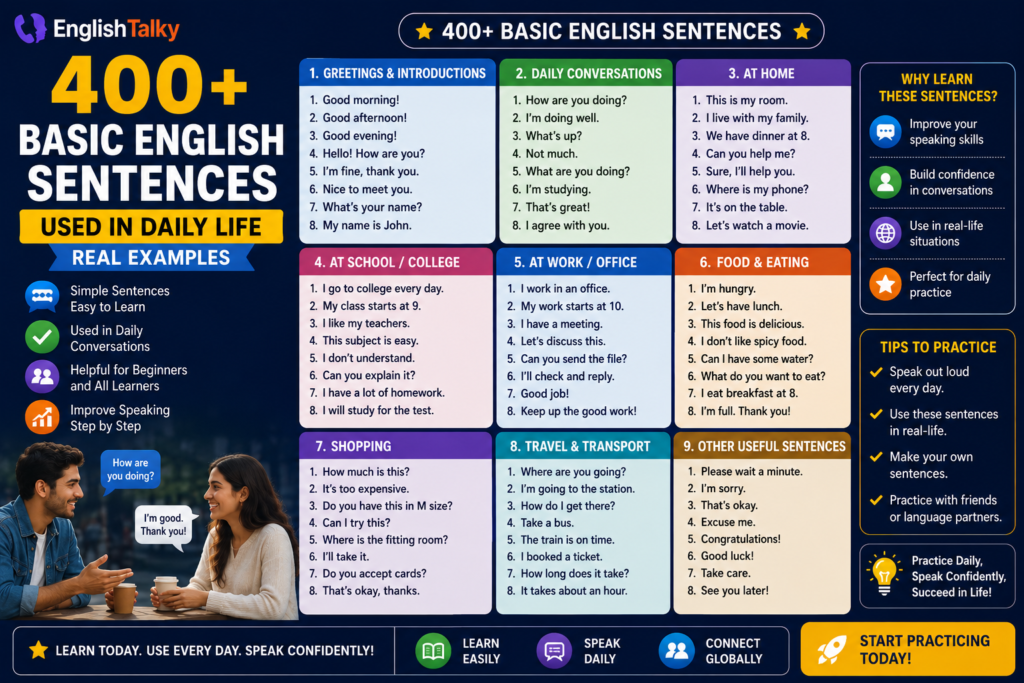
English is not learned only from grammar books. It is learned by using simple sentences every day—at home, at work, while shopping, traveling, chatting online, or talking with friends.
If your goal is to speak English confidently, the smartest approach is to master daily life English sentences that people actually use. This article brings together 21 real-life categories of English sentences, explained clearly and naturally, so you can start using them immediately.
Whether you are a beginner or an intermediate learner, this guide will help you think in English, speak without fear, and sound more natural.
Why Daily Life English Sentences Matter
Many learners struggle because:
- They focus too much on rules
- They memorize vocabulary without context
- They rarely practice real conversations
Daily-use sentences solve this problem. They help you:
- Speak faster and more confidently
- Reduce translation from your native language
- Communicate clearly, even with simple English
1. English Sentences Used at Home
Daily communication begins at home. This section highlights simple expressions used while talking to family members, managing routine activities, and sharing everyday moments in a relaxed and familiar setting.
- I just woke up.
- What’s for breakfast?
- I’m going to take a shower.
- Please switch off the lights.
- I’ll do it later.
- Dinner is ready.
- Don’t forget to lock the door.
- I’m feeling tired.
- Let’s watch a movie.
- I’ll clean it up.
- I’m done with my work.
- Can you help me for a minute?
- It’s time to eat.
- I need some rest.
- Please keep it down.
- I’ll be back soon.
- The room is messy.
- Let me finish this first.
- I’ll take care of it.
- Let’s clean the house.
2. Used in Daily Conversations
Casual interactions happen everywhere—at work, with friends, or in public places. This section focuses on everyday expressions used to start conversations, respond naturally, and keep discussions flowing in a comfortable and friendly way.
- How are you doing?
- What’s going on?
- Long time no see!
- That sounds good.
- I’m not sure.
- It depends.
- I agree with you.
- That’s interesting.
- Tell me more.
- I see what you mean.
- How’s everything going?
- What have you been up to?
- That makes sense.
- I was thinking the same.
- Really? I didn’t know that.
- That’s a good point.
- Let’s talk about it.
- I’m glad to hear that.
- Sounds like a plan.
- Thanks for letting me know.
3. Used at Work or Office
Workplace communication values clarity and courtesy. Commonly used expressions for meetings, emails, teamwork, and daily tasks are highlighted here, helping interactions remain professional, efficient, and respectful.
- I’ll get back to you.
- I’m working on it.
- Let’s discuss this later.
- I’ve sent you the email.
- Please let me know.
- I need some clarification.
- Can we reschedule the meeting?
- Thanks for the update.
- I’ll keep you posted.
- That works for me.
- I’ll look into it.
- Let me check and confirm.
- Could you please review this?
- I’ll share the details shortly.
- We’re on the same page.
- Let’s take this offline.
- I appreciate your support.
- I’ll follow up on this.
- Please feel free to ask.
- Let’s move forward with this.
4. Used While Shopping
Shopping often involves quick questions and decisions. This section highlights practical expressions for asking prices, checking availability, making payments, and handling returns, making everyday shopping interactions smoother and more confident.
- How much does this cost?
- Do you have this in another size?
- I’m just looking.
- Is there any discount?
- That’s too expensive.
- I’ll take this.
- Can I pay by card?
- Where is the billing counter?
- I’d like to return this.
- Do you have anything cheaper?
- Is this available in another color?
- Can I try this on?
- What’s the final price?
- Do you have this in stock?
- Is there a warranty on this?
- Can you pack this for me?
- I’ll come back later.
- Is this on sale?
- Can I exchange this?
- Do you accept UPI or cash?
5. Used While Traveling
Travel brings new places and new conversations. This section focuses on useful expressions for asking directions, handling transportation, seeking assistance, and communicating politely on the move, helping travel experiences feel easier and more comfortable.
- Where is the bus stop?
- How far is it from here?
- I need a ticket to Delhi.
- What time does it arrive?
- I think I’m lost.
- Can you show me the way?
- Is this seat taken?
- How long will it take?
- Thank you for your help.
- Could you help me, please?
- Which platform should I go to?
- Is this the right bus/train?
- Where can I buy a ticket?
- I’d like a window seat.
- When is the next departure?
- Does this go to the city center?
- Can you drop me here, please?
- I need a map.
- Is there a restroom nearby?
- I’ll get off at the next stop.
6. Used on the Phone
Phone conversations require quick understanding and clear responses. Common expressions for answering calls, sharing information, handling interruptions, and ending conversations politely are highlighted here, even without face-to-face cues.
- Hello, this is Ajay speaking.
- May I know who’s calling?
- I’ll call you back.
- Please hold on.
- Can you hear me clearly?
- The line is busy.
- I think the call got disconnected.
- Let’s talk later.
- I’ll message you.
- Thank you for calling.
- Can I call you in a few minutes?
- I’m in a meeting right now.
- Could you speak a little louder?
- I didn’t catch that.
- Let me put you on speaker.
- I’ll send you the details by message.
- Can you repeat that, please?
- I’ll save your number.
- Let’s continue this tomorrow.
- Talk to you soon.
7. For Asking Questions
Questions help conversations move forward. This section focuses on ways to seek information, request clarification, and understand situations better, making communication clearer and more effective in everyday life.
- What do you mean?
- Could you repeat that?
- Can you explain it again?
- What should I do next?
- Is it necessary?
- Why is that?
- How does it work?
- When will it be ready?
- Who is responsible?
- What’s the problem?
- Can you help me with this?
- What do you think about it?
- Is this the right way?
- How long will it take?
- Can I ask you something?
- What happens next?
- Is there another option?
- Could you give me an example?
- Where should I go?
- What do you suggest?
8. For Expressing Feelings
Emotions play a big role in communication. The expressions here help you share happiness, worry, excitement, or disappointment clearly, allowing others to understand how you feel in different situations.
- I’m really happy today.
- I feel nervous.
- I’m excited about this.
- I’m worried about it.
- That makes me angry.
- I’m disappointed.
- That’s a relief.
- I feel confident now.
- I’m proud of you.
- I feel relaxed.
- I’m feeling a bit stressed.
- That made my day.
- I feel overwhelmed right now.
- I’m thankful for your help.
- I feel much better now.
- I’m upset about this.
- That surprised me.
- I feel hopeful.
- I’m not comfortable with this.
- I feel motivated today.
9. Used in Social Situations
Public interactions often require courtesy and awareness. The expressions covered here support introductions, polite responses, and respectful behavior in gatherings, formal events, and everyday social settings.
- Nice to meet you.
- It’s a pleasure to meet you.
- Please have a seat.
- After you.
- Excuse me.
- Sorry for the inconvenience.
- Thank you very much.
- You’re welcome.
- Take care.
- Have a great day.
- Please go ahead.
- It was nice talking to you.
- Hope to see you again.
- Sorry to keep you waiting.
- Thank you for your time.
- I appreciate it.
- Please excuse my delay.
- Let me introduce myself.
- That’s very kind of you.
- Wishing you a nice day.
10. Used Online & on Social Media
Digital communication has its own style. The expressions here reflect everyday language used in chats, comments, posts, and messages, helping online conversations sound clear, friendly, and natural.
- I’ll text you.
- Seen your message.
- I’ll reply later.
- Let me check.
- I’m offline now.
- I shared the link.
- Check your inbox.
- I tagged you.
- Let’s connect.
- That post is interesting.
- Just saw this now.
- I’ll get back to you shortly.
- Thanks for sharing this.
- Please check the link.
- I’ve sent you a request.
- Let’s chat later.
- I commented on your post.
- DM me the details.
- I liked your post.
- Catch up soon online.
11. Used in Restaurants & Cafés
Eating out is one of the most common real-life situations where English is needed. These sentences help you order food, ask questions politely, respond to staff, and handle bills or issues confidently in restaurants, cafés, and food courts.
- Can I see the menu, please?
- What do you recommend?
- I’d like to order this.
- Is this dish spicy?
- Can we get some water?
- How long will it take?
- The food was delicious.
- This isn’t what I ordered.
- Could we have the bill, please?
- Do you accept cards?
- Could we get a table for two?
- Is this vegetarian?
- Can I get this without onions?
- I’ll have the same.
- Could you make it less spicy?
- Is service charge included?
- We’re ready to order.
- Can we get separate bills?
- Everything was great, thank you.
- Could we get this packed?
12. Used at School or College
These sentences are commonly used in classrooms, lectures, exams, and campus conversations. They help students ask questions, understand lessons, interact with teachers, and communicate clearly in academic settings.
- What’s today’s lesson?
- I didn’t understand this part.
- Can you explain it again?
- May I come in?
- When is the exam?
- I need more time.
- I forgot my notebook.
- I’ll submit it tomorrow.
- The class was interesting.
- Thank you, teacher.
- May I ask a question?
- Could you please repeat that?
- I’m not prepared today.
- When is the submission deadline?
- I was absent yesterday.
- Can I work in a group?
- Is this included in the syllabus?
- I need help with this topic.
- The lecture was very clear.
- I’ll prepare better next time.
13. Used While Giving Directions
These sentences are used to guide someone from one place to another. They help you explain routes clearly using landmarks, distance, and simple instructions, especially in public places and while traveling.
- Go straight ahead.
- Turn left at the signal.
- It’s near the bus stop.
- It’s far from here.
- You’ll see it on the right.
- Take the first right.
- It’s opposite the bank.
- Walk for five minutes.
- You can’t miss it.
- Follow me.
- Turn right at the next corner.
- Go past the traffic signal.
- It’s just around the corner.
- Keep going straight.
- It’s next to the supermarket.
- Cross the road carefully.
- Take the second left.
- It’s behind the building.
- You’ll reach it soon.
- Ask someone there for help.
14. Used for Making Requests
These sentences help you ask for help, information, or favors politely in everyday situations. Using the right request sentences makes your English sound respectful, confident, and natural.
- Could you help me, please?
- Can you do me a favor?
- Would you mind waiting?
- Can I borrow this?
- Please take a look at this.
- Could you speak slowly?
- May I ask something?
- Can you repeat that?
- Please let me know.
- I’d appreciate it.
- Could you give me a moment?
- Would you please explain this?
- Can you check this for me?
- Do you mind if I sit here?
- Could you send it again?
- May I use your phone?
- Can you help me with this form?
- Please inform me in advance.
- Would it be okay to leave early?
- Could you remind me later?
15. Used for Apologizing
Apologies are an important part of polite communication. This section covers common ways to admit mistakes, express regret, and take responsibility in a calm and respectful manner, whether in personal or professional situations.
- I’m sorry about that.
- My apologies.
- That was my mistake.
- I didn’t mean to do that.
- Please forgive me.
- Sorry for the inconvenience.
- It won’t happen again.
- I take responsibility.
- I should’ve informed you.
- Thanks for understanding.
- I’m really sorry for the delay.
- Please accept my apology.
- I didn’t realize that earlier.
- I apologize for the confusion.
- That was unintentional.
- I regret the inconvenience caused.
- I should have been more careful.
- I’m sorry if that caused trouble.
- Thanks for your patience.
- I’ll make sure it doesn’t happen again.
16. Used for Giving Opinions
Sharing thoughts and viewpoints is part of everyday conversation. This section focuses on expressing personal ideas, preferences, and beliefs clearly, while still sounding polite and open to other perspectives.
- I think this is better.
- In my opinion, it’s useful.
- I believe it will work.
- I don’t agree with that.
- From my experience, it’s good.
- I prefer the first option.
- It seems unnecessary.
- That makes sense to me.
- I have a different opinion.
- I feel this is right.
- I think we should try this.
- Personally, I like this idea.
- I’m not convinced about that.
- I see it differently.
- To me, this feels right.
- I’m in favor of this.
- I’m not sure I agree completely.
- That’s just my view.
- I think there’s a better option.
- From my point of view, it works.
17. Used for Agreeing & Disagreeing
Conversations often involve different viewpoints. This part highlights natural ways to support an idea, respond positively, or express a different opinion politely, helping discussions stay respectful and balanced.
- I totally agree.
- You’re absolutely right.
- That’s true.
- I feel the same way.
- I’m not sure about that.
- I don’t think so.
- I respectfully disagree.
- That’s not always true.
- Let’s agree to disagree.
- You have a point.
- I agree with you on this.
- That’s exactly what I meant.
- I see your point.
- I’m not completely convinced.
- I have a different take on this.
- That may be true, but…
- I don’t fully agree.
- We might see this differently.
- I understand your view.
- Let’s look at it another way.
18. Used in Emergencies
In urgent situations, clear communication can make a real difference. This section focuses on expressions used to ask for help, describe problems quickly, and respond during critical moments, where clarity and speed matter most.
- I need help!
- It’s an emergency.
- Call an ambulance.
- I’m not feeling well.
- There’s been an accident.
- Please hurry.
- Is anyone hurt?
- I need a doctor.
- Stay calm.
- Everything will be okay.
- Please call the police.
- I need medical assistance.
- Someone has fainted.
- There’s a fire.
- I can’t breathe properly.
- We need help right now.
- It’s very urgent.
- Is there a hospital nearby?
- Please help us.
- Move back and stay safe.
19. Used for Time & Scheduling
Talking about time is part of daily planning. This section covers phrases used to arrange meetings, manage schedules, mention delays, and coordinate plans in both personal and professional situations.
- What time is it?
- I’ll be there soon.
- Let’s meet at 5 PM.
- I’m running late.
- Can we postpone it?
- The meeting is cancelled.
- I’m free today.
- What’s your schedule?
- Let’s fix a time.
- I’ll remind you.
- What time works for you?
- I’ll be on time.
- Can we move it to tomorrow?
- Let’s meet a little earlier.
- I’ll be available after lunch.
- Please let me know the timing.
- The deadline is approaching.
- I need more time to finish this.
- Let’s reschedule for next week.
- I’ll update you on the time.
20. Used for Motivation & Encouragement
Positive words can boost confidence and lift spirits. This section focuses on expressions that inspire, support others, and offer reassurance, especially during challenges, learning, or personal growth.
- You can do it.
- Don’t give up.
- Keep going.
- Believe in yourself.
- You’re doing great.
- Stay positive.
- Take it step by step.
- Everything will be fine.
- I’m proud of you.
- Keep practicing.
- You’re improving every day.
- Keep up the good work.
- Don’t be too hard on yourself.
- You’ve got this.
- Just keep trying.
- Mistakes help you learn.
- Stay focused and calm.
- Trust the process.
- I believe in you.
- You’re on the right track.
21. Used for Making Plans & Future Intentions
Talking about the future is a regular part of daily communication. Expressions in this category help discuss plans, set intentions, talk about goals, and arrange upcoming activities, making conversations about what comes next clear and natural.
- I’m planning to start tomorrow.
- Let’s meet this weekend.
- I’ll call you later today.
- We’re thinking about going out.
- I hope to finish this soon.
- I’m looking forward to it.
- Let’s decide later.
- I’ll let you know in advance.
- We’ll see how it goes.
- I’m planning ahead this time.
How to Practice These Sentences Effectively
Learning sentences is only the first step. Real improvement comes from using them actively and consistently in daily life.
Speak them out loud every day
Reading silently is not enough. Say the sentences aloud while doing daily activities—at home, while walking, or even when you’re alone. This helps your mouth, ears, and brain get comfortable with English sounds and rhythm.
Use them in real conversations
Try to include these expressions when talking to friends, colleagues, or language partners. Even short conversations build confidence. The goal is not long speeches, but regular, natural usage.
Don’t fear mistakes
Mistakes are a normal part of learning. Most people care about understanding your message, not your grammar. Each mistake teaches you something new and brings you closer to fluency.
Focus on clarity, not perfection
Clear communication matters more than perfect English. Simple sentences spoken confidently are far more effective than complex ones spoken with hesitation. Fluency grows when you prioritize being understood.
With steady practice and a positive mindset, these small daily efforts turn into strong speaking skills over time.
Final Thoughts
You don’t need advanced English to communicate well. What truly matters is knowing the right sentences and using them naturally in the right situations. Clear, simple expressions often communicate ideas more effectively than complex vocabulary or perfect grammar.
By mastering daily life English sentences and practicing them consistently, you gradually build confidence, reduce hesitation, and begin to think in English instead of translating from your native language. Even small improvements, repeated every day, lead to noticeable progress in speaking ability.
English is a practical skill, not a test. And like any skill, it grows with regular use. The more you speak, listen, and interact, the more comfortable and confident you become—one conversation at a time.