
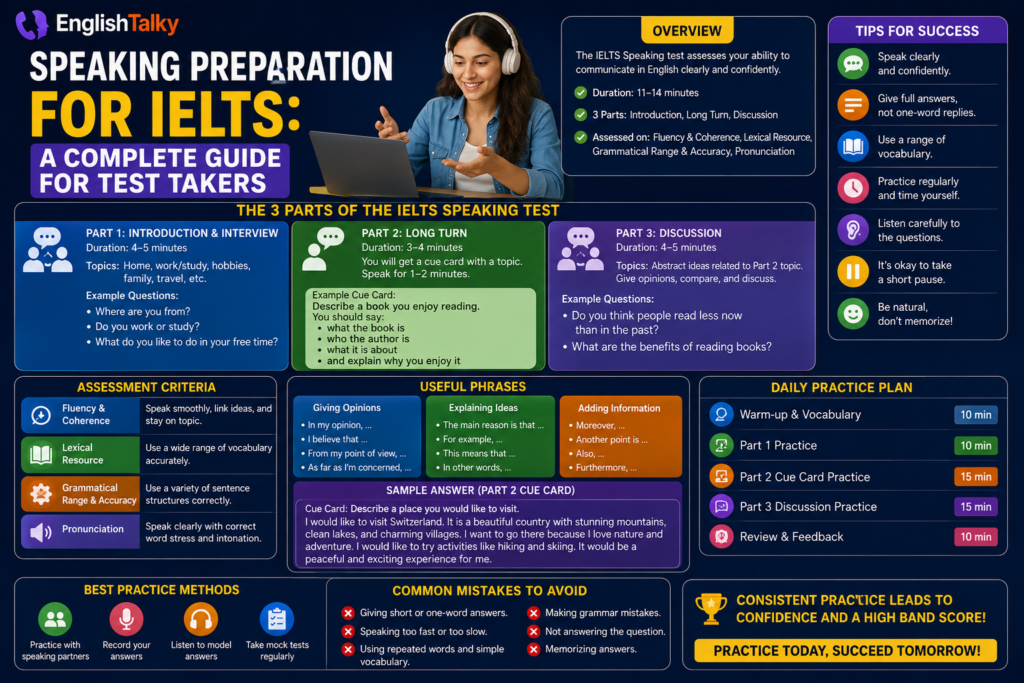
The IELTS Speaking test is often considered the most challenging part of the exam—not because it is technically complex, but because it requires confidence, clarity, and real-time communication skills. Unlike reading or writing, you cannot pause to think for long, rewrite an answer, or correct mistakes once spoken. This makes structured and consistent speaking preparation essential for anyone aiming for a high IELTS band score.
This article provides a comprehensive guide to IELTS Speaking preparation, including test format, common challenges, effective strategies, daily practice plans, and useful tools to improve performance.
Understanding the IELTS Speaking Test Format
Before beginning preparation, it is important to understand how the Speaking test works. The test is conducted as a face-to-face interview with a certified examiner and lasts 11–14 minutes. It is divided into three parts:
Part 1: Introduction and Interview (4–5 minutes)
In Part 1 of the test, the examiner begins by introducing themselves and confirming the candidate’s identity. This short warm-up helps candidates feel comfortable before the actual assessment begins.
The examiner then asks questions about familiar, everyday topics such as:
- Your home or hometown
- Work or studies
- Family and friends
- Hobbies and interests
- Daily routines, food, travel, or free-time activities
These questions are simple and personal, and they do not require any technical knowledge. The goal is not to test what you know, but how well you can communicate basic ideas in English.
This part primarily assesses:
- Basic fluency – your ability to speak without long pauses or excessive hesitation
- Pronunciation – how clearly your words are understood, including stress and intonation
- Simple grammatical accuracy – correct use of common tenses and sentence structures
- Ability to give relevant, natural answers – responding appropriately without memorizing
Candidates are expected to give short but complete answers, usually 2–4 sentences. Very short replies can limit your score, while memorized or overly long responses may sound unnatural.
Part 1 sets the tone for the rest of the interview. Speaking confidently, maintaining a natural pace, and answering honestly can help you make a strong first impression and feel more relaxed for the later sections of the test.
Part 2: Long Turn (3–4 minutes)
In Part 2 of the test, the examiner gives you a cue card with a specific topic. The card includes a main question and a few bullet points to guide your response.
You are given 1 minute to prepare. During this time, you can make short notes on the paper provided. These notes are only for your reference and will not be evaluated. After the preparation time, you are expected to speak continuously for up to 2 minutes. The examiner will stop you when the time is over and may ask one brief follow-up question.
This part of the test is designed to assess your ability to:
- Speak at length without interruption, showing sustained fluency
- Organize ideas logically, using a clear beginning, middle, and ending
- Stay on topic, covering all parts of the cue card naturally
- Use a range of vocabulary and sentence structures appropriately
- Maintain coherence, using linking words and examples to support ideas
Unlike Part 1, this section requires you to speak in a more extended and structured manner. You are not expected to give a perfect speech, but you should aim to keep talking smoothly without long pauses. Minor mistakes are acceptable as long as communication remains clear.
A helpful approach is to structure your answer like a short story: introduce the topic, explain key points, give examples or personal experiences, and briefly conclude. Staying calm and focusing on communication rather than perfection will help you perform well in this section.
Part 3: Discussion (4–5 minutes)
In Part 3 of the test, the examiner asks more abstract and in-depth questions that are thematically connected to the topic discussed in Part 2. This section moves beyond personal experiences and focuses on ideas, opinions, and general issues.
The questions may involve:
- Comparing past and present situations
- Discussing causes and effects
- Talking about advantages and disadvantages
- Expressing opinions on social trends or future changes
- Evaluating problems and suggesting solutions
This part of the test evaluates your ability to:
- Think and respond critically in English, often without much preparation time
- Form and justify opinions clearly, using reasons and examples
- Use more advanced vocabulary and grammar, including complex sentence structures
- Develop answers logically, rather than giving short or superficial responses
- Maintain fluency in a discussion-style conversation, similar to an academic or professional exchange
Candidates are expected to give longer, more detailed answers than in Part 1. While there is no fixed length, your responses should show depth and development. It is acceptable to take a brief moment to think, but long pauses should be avoided.
Part 3 is often considered the most challenging section because it requires both language proficiency and analytical thinking. Speaking clearly, structuring answers with reasons and examples, and using a calm, confident tone can significantly improve performance in this final stage of the test.
Understanding these stages helps you prepare strategically instead of practicing randomly.
IELTS Speaking Band Descriptors Explained
In the IELTS Speaking test, your performance is evaluated using four official band descriptors, and each criterion carries equal weight. This means that focusing on only one area—such as vocabulary or grammar—is not enough to achieve a high band score. Balanced improvement across all four areas is essential.
Below is a detailed explanation of each criterion:
Fluency and Coherence
This criterion measures how smoothly and naturally you speak. Examiners look at:
- Your ability to speak without frequent pauses or hesitation
- Logical flow of ideas from one point to the next
- Effective use of linking words such as because, however, for example, and as a result
Occasional pauses are normal, but excessive hesitation or repetition can reduce your score. Clear organization of ideas helps the listener follow your response easily.
Lexical Resource
Lexical Resource refers to your range and accuracy of vocabulary. This includes:
- Using appropriate words for different topics
- Avoiding overuse of basic or repetitive vocabulary
- Correct word choice and natural expressions
- Ability to paraphrase when you don’t know an exact word
Using advanced vocabulary is helpful, but only when it is used correctly and naturally. Incorrect or forced vocabulary can negatively affect your score.
Grammatical Range and Accuracy
This criterion evaluates how well you use grammar while speaking. Examiners assess:
- Variety of sentence structures (simple, compound, and complex)
- Correct use of tenses, articles, and prepositions
- Ability to form clear and understandable sentences
Minor grammatical mistakes are acceptable, especially at higher levels, as long as they do not interfere with meaning. A mix of accuracy and variety is more important than perfect grammar.
Pronunciation
Pronunciation focuses on how clearly you are understood, not on having a native accent. Examiners consider:
- Clarity of individual sounds
- Word and sentence stress
- Intonation and rhythm
- Overall ease of understanding
A strong accent is acceptable if your speech is clear and consistent. Good pronunciation helps your ideas come across confidently and effectively.
Note on Preparation
Effective IELTS Speaking preparation should focus on developing all four areas together through regular speaking practice. Memorizing answers may reduce fluency and sound unnatural. Instead, aim to communicate clearly, organize ideas logically, and speak confidently across a wide range of topics.
Balanced preparation leads to more natural speech and higher band scores.
Common Challenges Faced by IELTS Speaking Candidates
Many candidates struggle not because of lack of knowledge, but due to specific speaking-related issues:
- Fear of making grammatical mistakes
- Long pauses while thinking
- Overuse of simple words and structures
- Translating thoughts from the native language
- Lack of confidence during face-to-face interaction
Identifying your personal challenges early makes preparation more targeted and effective.
Effective Strategies for Preparation
1. Practice Speaking Daily (Not Just Reading or Writing)
IELTS Speaking is a practical communication skill, and it improves only through regular, active speaking. While reading sample answers or writing responses can help with vocabulary and structure, they do not train you to think and respond in real time, which is essential during the speaking test.
Reading silently allows you more time to process language, and writing gives you the opportunity to correct mistakes. However, in the test, you must respond immediately and spontaneously, without editing or long pauses. This is why daily speaking practice is crucial.
Speaking aloud every day helps you:
- Build fluency and reduce hesitation
- Improve pronunciation and sentence stress
- Train your brain to think in English
- Gain confidence in expressing ideas clearly
You can practice even when you are alone. Describe your day, explain your opinions on common topics, or answer sample IELTS questions out loud. Recording your responses and listening back can also help you identify areas for improvement.
Consistency matters more than duration. Even 15–20 minutes of daily speaking practice is more effective than long but irregular study sessions. Over time, regular speaking will make your responses more natural, confident, and fluent during the actual IELTS interview.
2. Think in English Instead of Translating
One of the most common habits among IELTS candidates is thinking in their native language and then translating into English. While this may feel natural at first, it often leads to long pauses, grammatical errors, and unnatural sentence structures during the speaking test.
To perform well in Speaking, it is important to train your mind to respond directly in English. When you think in English, your answers become faster, smoother, and more natural, which directly improves fluency and coherence.
Translation causes problems because:
- It increases hesitation while searching for equivalent words
- Sentence structures from your native language may not work well in English
- You may lose confidence when you cannot translate a word quickly
Start with simple thoughts and everyday situations. For example, describe what you are doing, what you see around you, or how you feel—using basic English sentences. As your comfort level improves, gradually move on to more complex ideas, such as giving opinions, explaining reasons, or discussing abstract topics.
Regular exposure to English through listening and speaking also helps your brain adapt. Over time, thinking in English becomes automatic, allowing you to respond more confidently and naturally in the Speaking test without relying on translation.
3. Focus on Clarity, Not Accent
Many IELTS candidates worry unnecessarily about having a British or American accent, but this is not a requirement for a high band score. IELTS is an international test, and examiners are trained to understand a wide range of accents from around the world.
What truly matters is clarity of speech. Examiners assess how easily they can understand what you are saying, not how closely your accent matches that of a native speaker.
Clear pronunciation involves:
- Saying individual sounds correctly so words are recognizable
- Using proper word stress, especially in longer or unfamiliar words
- Applying natural sentence stress and intonation to highlight meaning
Even if you have a strong regional accent, you can still score well as long as your speech is clear and consistent. Problems arise only when pronunciation makes it difficult for the listener to understand your message.
Instead of trying to copy a native accent, focus on speaking slowly and clearly, opening your mouth properly, and finishing words fully. Listening to clear English speakers and repeating short phrases aloud can help improve pronunciation and confidence.
Prioritizing clarity over accent leads to more effective communication and better performance in the Speaking test.
4. Use Natural Linking Words
Linking words play an important role in making your IELTS Speaking answers sound organized, fluent, and easy to follow. They help connect ideas smoothly and show the examiner that you can structure your thoughts clearly while speaking.
Words and phrases such as however, for example, on the other hand, because of this, as a result, and in addition allow you to:
- Move logically from one idea to another
- Add explanations or examples naturally
- Compare or contrast different points of view
- Sound more confident and fluent
Using linking words effectively improves both fluency and coherence, which are key scoring criteria in IELTS Speaking.
However, it is important to use these words naturally and appropriately. Overusing them or forcing complex connectors into every sentence can make your speech sound unnatural. Simple connectors like and, but, so, and because are equally acceptable when used correctly.
A good practice method is to focus on one or two linking words per answer, using them where they genuinely help clarify your ideas. With regular speaking practice, these connectors will become a natural part of your speech, making your responses more structured and easier to understand during the IELTS interview.
5. Expand Answers Without Memorizing
In the test, very short answers can limit your fluency and coherence score, as they do not give the examiner enough language to evaluate. At the same time, memorized answers are easily recognized and may sound unnatural, which can negatively affect your performance.
The key is to expand your answers naturally, without trying to memorize full responses. Natural expansion shows that you can think independently in English and communicate ideas clearly.
You can expand an answer by:
- Explaining why you think or feel a certain way
- Describing how something works or how often it happens
- Giving examples from your personal experience
- Adding a brief result or opinion
For example, instead of saying:
“Yes, I like traveling.”
You can say:
“Yes, I enjoy traveling because it allows me to experience new cultures. For example, when I visit new places, I learn a lot about local traditions and food.”
This approach keeps your answers flexible and natural. It also allows you to adapt easily to different questions without relying on memorized content.
Practicing this technique regularly helps improve fluency, coherence, and confidence, making your responses sound more conversational and appropriate for the test.
How to Prepare for Each IELTS Speaking Part
Preparing for Part 1
- Practice common topics such as family, food, work, studies, and hobbies
- Answer in 2–4 sentences, not just “yes” or “no”
- Sound natural and conversational
Example:
Do you like music?
Instead of: “Yes, I like music.”
Say: “Yes, I enjoy listening to music, especially while relaxing in the evening. It helps me reduce stress.”
Preparing for Part 2
- Practice speaking for 2 full minutes
- Use a simple structure: introduction → main points → example → conclusion
- Do not worry if you make a mistake—continue speaking
A useful trick is to imagine you are telling a story to a friend, not answering an exam question.
Preparing for Part 3
- Practice expressing opinions clearly
- Learn to compare ideas, discuss advantages and disadvantages, and talk about future trends
- Use slightly more formal language than Part 1
This section tests your ability to think critically in English.
Daily Practice Plan (30–45 Minutes)
- 10 minutes – Read a topic and think of ideas in English
- 15 minutes – Speak aloud (record yourself if possible)
- 10 minutes – Listen and note mistakes
- 10 minutes – Improve vocabulary or sentence structures
Consistency matters more than long study hours.
Useful Tools for Speaking Practice
While practicing with friends or teachers is ideal, technology can play a major role in speaking preparation.
One helpful platform is EnglishTalky, which allows learners to practice spoken English through real conversations. Such platforms are useful for:
- Improving fluency through regular speaking
- Gaining confidence in real-time communication
- Practicing everyday and exam-style topics
Using speaking-focused tools alongside self-practice can significantly improve performance.
Final Tips for IELTS Speaking Success
- Do not aim for perfection—aim for clarity and confidence
- Speak at a natural pace, not too fast
- If you don’t understand a question, politely ask the examiner to repeat it
- Stay calm and treat the test like a conversation
With structured preparation, regular speaking practice, and the right tools, achieving a high band score in Speaking is absolutely possible.
Conclusion
IELTS Speaking preparation is not about memorizing answers, but about building the ability to communicate naturally and confidently in English. By understanding the test format, practicing daily, focusing on fluency, and using supportive tools, candidates can steadily improve their speaking skills and perform well on test day.