
Updated on 12-04-2026
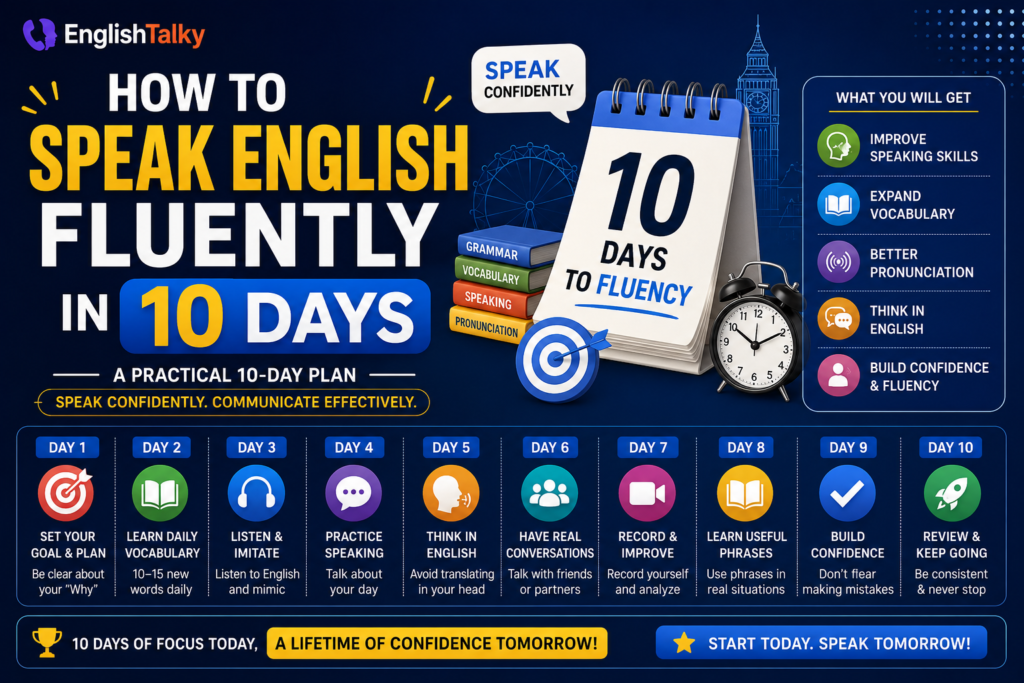
Fluency in English is a goal many people chase for years. But what if you could make visible, real progress in just 10 days? Let’s be clear—complete mastery in 10 days isn’t realistic. However, you can dramatically improve your confidence, speaking ability, and fluency habits within this short period if you follow a structured and intense approach.
This guide is designed to help you start speaking English naturally, reduce hesitation, and build fluency fast. It focuses on action over theory, because fluency comes from speaking—not just studying.
What Does “Fluency” Really Mean?
Before we begin, it’s important to understand fluency. Fluency does not mean:
- Knowing every grammar rule
- Having a perfect accent
- Using complex vocabulary
Fluency means:
- Speaking smoothly without long pauses
- Expressing your thoughts clearly
- Understanding and responding quickly
The goal of this 10-day plan is to help you think in English and speak without fear.
Ground Rules for the 10-Day Challenge
To get the best results, follow these rules strictly:
- Speak daily (minimum 2 hours total practice)
- Avoid your native language during practice time
- Don’t fear mistakes—focus on communication
- Use simple English instead of complicated words
- Be consistent—no skipping days
Day 1: Build the Speaking Habit
Goal: Start Speaking Without Fear
The biggest obstacle in learning spoken English is not vocabulary or grammar—it’s fear. Many learners wait for the “perfect moment” when they feel fully prepared. The truth is, that moment never comes. Fluency begins the moment you start speaking, even imperfectly.
Day 1 is about breaking your mental barrier. You are not trying to speak perfect English today. You are simply training your brain and mouth to get used to speaking English regularly.
Why This Step Is Important
When you don’t practice speaking:
- Your brain keeps translating from your native language
- You hesitate and pause too much
- You feel nervous when talking to others
But when you start speaking from Day 1:
- Your brain adapts quickly
- You become more confident
- You reduce hesitation naturally
Think of it like going to the gym. The first day is not about lifting heavy weights—it’s about showing up and starting.
Task 1 (Day 1): Mirror Speaking (10–15 Minutes)
Stand in front of a mirror and start talking about yourself. This may feel strange at first, but it is one of the most powerful techniques to build confidence.
Why Mirror Practice Works:
- You simulate real conversation
- You become aware of your facial expressions and body language
- You reduce fear of speaking in front of others
What to Talk About:
Start with simple topics. Don’t overthink.
1. Introduction
- “My name is Ajesh.”
- “I am from Kerala.”
- “I live in a small town.”
2. Family
- “There are four people in my family.”
- “My father is a driver.”
- “My mother is a homemaker.”
3. Work / Study
- “I am working on a mobile app.”
- “I like learning new things.”
4. Daily Routine
- “I wake up at 7 in the morning.”
- “I drink tea and check my phone.”
- “I go to work at 9.”
Important Rule:
Do not stop speaking.
Even if you don’t know a word, keep going.
Task 2 (Day 1): Use Simple English
Many learners get stuck because they try to sound “advanced.” This creates pressure and leads to silence.
Instead, focus on simple and clear communication.
Example:
❌ “I am employed in a multinational corporation”
✅ “I work in a big company”
❌ “I reside in a metropolitan city”
✅ “I live in a big city”
❌ “I consume my meals at regular intervals”
✅ “I eat my food on time”
Key Principle:
Simple English = Fluent English
Fluency is not about big words. It’s about speaking smoothly and confidently.
Task 3 (Day 1): Voice Recording (10 Minutes)
After your mirror practice, record your voice on your phone.
What to Do:
- Speak about the same topics again
- Try to speak continuously for at least 5–10 minutes
- Don’t pause or restart frequently
Then Listen Carefully:
Ask yourself:
- Did I hesitate too much?
- Did I repeat words often?
- Was my speech clear?
Why This Helps:
- You become aware of your mistakes
- You can track improvement over time
- You build confidence hearing your own voice
At first, you may feel uncomfortable listening to yourself. That’s normal. Keep doing it—you will improve quickly.
Task 4 (Day 1): Handle “I Don’t Know the Word” Moments
This is one of the biggest problems learners face.
When you don’t know a word, you have 3 options:
1. Use Simple Alternatives
If you don’t know “vehicle,” say “car” or “bike”
2. Explain the Idea
If you don’t know “microwave,” say:
“It is a machine to heat food”
3. Skip and Continue
Don’t get stuck. Move forward.
Practice Example:
You want to say:
“I use a blender to make juice”
But you don’t know “blender”
Say:
“I use a machine to make juice”
Task 5 (Day 1): Build Flow, Not Perfection
Your focus today should be:
- Speaking continuously
- Reducing long pauses
- Expressing ideas
Not:
- Perfect grammar
- Perfect pronunciation
Example:
❌ “Yesterday I go to market and buy vegetables” (Wrong grammar but okay)
✔ You communicated successfully
Remember:
Communication is more important than correctness in the beginning.
Bonus Exercise: Think and Speak Together
As you go through your day, try to speak small sentences in English.
Examples:
- “I am drinking tea”
- “I am walking now”
- “The weather is hot”
This builds the habit of thinking in English, which is essential for fluency.
Common Problems on Day 1 (And Solutions)
Problem 1: “I feel shy”
👉 Solution: Practice alone first. Confidence builds gradually.
Problem 2: “I don’t know enough words”
👉 Solution: Use simple words and repeat them.
Problem 3: “I keep stopping”
👉 Solution: Force yourself to continue, even with broken sentences.
End of Day 1 Checklist
By the end of today, you should have:
✔ Spoken in front of a mirror for at least 10–15 minutes
✔ Recorded your voice and listened to it
✔ Practiced speaking without stopping
✔ Used simple English instead of complex words
Final Motivation for Day 1
Today is not about being perfect—it’s about starting.
If you complete Day 1 honestly, you have already done what most learners never do:
you started speaking.
That is the most important step toward fluency.
Tomorrow, you will build on this foundation and start using ready-made sentences to speak more naturally.
Action for now:
Go stand in front of a mirror and start speaking. Don’t wait. Don’t think. Just begin.
Day 2: Learn Survival Sentences
Goal: Speak Basic Sentences Automatically
On Day 1, you started speaking without fear. Now, on Day 2, your goal is to speak faster and more naturally by using ready-made sentences.
Many learners think they need a large vocabulary to speak fluently. That’s not true. In real life, people use the same common sentences again and again. If you master these, your speaking becomes smooth and automatic.
These are called “survival sentences”—simple, practical sentences you can use in daily conversations without thinking too much.
Why Survival Sentences Are Powerful
When you try to create sentences word by word:
- You hesitate
- You make more mistakes
- You lose confidence
But when you use ready-made sentences:
- You speak faster
- You sound more natural
- You don’t need to translate in your mind
Think of it like this:
Instead of building a house brick by brick every time, you are using pre-built blocks.
Task 1 (Day 2): Learn 30–40 Daily Sentences
Start by learning common sentences used in everyday conversations. Don’t just read them—say them aloud multiple times.
Here are some useful categories:
1. Greetings & Daily Conversation
- “How was your day?”
- “What are you doing now?”
- “Did you eat?”
- “What’s going on?”
- “How have you been?”
2. Expressing Opinions
- “I think that’s a good idea”
- “I don’t think that will work”
- “In my opinion, it’s better to wait”
- “That makes sense”
3. Asking for Help / Clarification
- “Can you explain that again?”
- “What do you mean?”
- “Can you speak slowly?”
- “I didn’t understand that”
4. Agreeing / Disagreeing
- “Yes, I agree”
- “You’re right”
- “I’m not sure about that”
- “I don’t agree with you”
5. Daily Actions
- “I’m getting ready”
- “I’m on my way”
- “I’ll call you later”
- “Let’s talk after some time”
Task 2 (Day 2): Repeat Until It Becomes Automatic
Learning sentences once is not enough. You need repetition.
Practice Method:
- Pick 10 sentences
- Say each sentence 10 times aloud
- Focus on:
- Smooth flow
- Clear pronunciation
- Natural speed
Then move to the next 10 sentences.
Pro Tip:
Speak with emotion and expression, not like a robot.
Example:
Instead of flat tone → “How was your day”
Say it naturally → “How was your day?” 😊
This helps you sound more real in conversations.
Task 3 (Day 2): Use Sentences in Your Own Situations
Memorizing is not enough. You must use the sentences in real-life contexts.
Example Practice:
Sentence: “What are you doing now?”
Use it like:
- Ask a friend
- Say it while imagining a conversation
- Use it during a phone call
Self-Practice Technique:
Create imaginary conversations.
Example:
You: “What are you doing now?”
You (as other person): “I’m watching a movie”
You: “Oh nice, which movie?”
This helps you practice both sides of a conversation.
Task 4 (Day 2): Customize the Sentences
Don’t just copy—make them personal.
Example:
Original: “I think that’s a good idea”
Customized: “I think that’s a good idea for our app”
Original: “I’m on my way”
Customized: “I’m on my way to the office”
This makes your English more useful and relevant.
Task 5 (Day 2): Practice in Real Conversations
If possible, use these sentences with:
- Friends
- Colleagues
- Language partners
If you don’t have anyone:
- Talk to yourself
- Use apps or online platforms
- Practice in front of a mirror
Daily Practice Routine for Day 2
- 20 minutes: Learn new sentences
- 20 minutes: Repeat aloud
- 20 minutes: Create your own sentences
- 20 minutes: Practice conversations
Common Mistakes to Avoid
1. Only Reading, Not Speaking
Reading silently won’t help. You must speak aloud.
2. Trying to Learn Too Many Sentences at Once
Focus on 30–40 useful sentences, not 100+.
3. Not Using Them in Real Life
If you don’t use them, you will forget them quickly.
Bonus Exercise: Sentence Transformation
Take one sentence and change it slightly.
Example:
Base: “I’m going now”
- “I’m going home now”
- “I’m going to work now”
- “I’m going outside now”
This helps you create multiple sentences from one pattern.
End of Day 2 Checklist
By the end of today, you should have:
✔ Learned 30–40 daily sentences
✔ Practiced speaking them aloud multiple times
✔ Used them in your own examples
✔ Tried simple conversations using these sentences
Final Motivation for Day 2
Today, you are building the foundation of real communication.
You don’t need perfect grammar or big vocabulary to speak English.
You just need useful sentences that come naturally to you.
If you practice properly today, tomorrow you will notice:
- Faster speaking
- Less hesitation
- More confidence
Action for now:
Pick 10 sentences and start speaking them aloud. Don’t just read—speak with energy and confidence.
Day 3: Think in English
Goal: Stop Translating in Your Mind
By Day 3, you’ve already started speaking and using common sentences. Now it’s time to fix one of the biggest obstacles to fluency: translating from your native language.
Most learners follow this process:
- Think in native language
- Translate into English
- Speak
This takes time, creates hesitation, and breaks your flow.
Fluent speakers do this instead:
- Think in English
- Speak
That’s what you will start building today.
Why Translation Slows You Down
When you translate:
- Your brain works twice as hard
- You pause frequently
- You lose confidence mid-sentence
Example:
You think in Hindi:
“मैं कल बाज़ार गया था”
Then translate:
“I yesterday market went…”
Now you get confused with grammar.
But if you think directly in English:
“I went to the market yesterday”
→ Faster, smoother, and clearer.
What Does “Thinking in English” Mean?
It does NOT mean:
- Using difficult words
- Speaking long sentences
It means:
- Using simple, direct thoughts in English
- Creating small sentences quickly
- Observing and describing in real-time
Task 1 (Day 3): Observe and Describe Your Surroundings
Start with what you can see right now.
Look around and describe everything in simple English.
Examples:
- “The fan is moving fast”
- “The room is quiet”
- “My phone is on the table”
- “The window is open”
- “It is very hot today”
How to Practice:
- Sit in a room
- Look at objects one by one
- Speak short sentences about them
Do this for 10–15 minutes.
Important Rule:
Use simple words only.
Don’t try to sound advanced.
Task 2 (Day 3): Talk to Yourself Throughout the Day
This is one of the most powerful habits.
You don’t need a partner. You can practice anytime, anywhere.
Examples:
While eating:
- “I am eating rice”
- “This food is spicy”
While walking:
- “I am walking on the road”
- “There are many people here”
While working:
- “I am checking my phone”
- “I need to finish this task”
Why This Works:
- You train your brain to think in English naturally
- You reduce dependence on translation
- You improve fluency without pressure
Task 3 (Day 3): Convert Your Thoughts Instantly
This is the main exercise of Day 3.
Whenever you think something in your native language, immediately convert it into English.
Example:
You think:
“मुझे चाय पीनी है”
Immediately say:
“I want to drink tea”
Another example:
You think:
“यहाँ बहुत गर्मी है”
Convert to:
“It is very hot here”
Practice Method:
- Notice your thoughts
- Translate them quickly into simple English
- Say them aloud or in your mind
Task 4 (Day 3): Use Short Sentences Only
Many learners try to think in long, complex sentences. This creates pressure.
Instead, use small, easy sentences.
Example:
❌ “I am feeling extremely exhausted due to excessive workload”
✅ “I am very tired”
❌ “I am currently engaged in completing my professional tasks”
✅ “I am working now”
Key Rule:
Short sentences = Fast thinking = Better fluency
Task 5 (Day 3): Build Continuous Thinking
At first, you may only think in English for a few seconds. That’s okay.
Gradually increase your time.
Practice Goal:
- Start with 5 minutes
- Then 10 minutes
- Then 20 minutes
Try to think in English during simple activities like:
- Brushing
- Walking
- Eating
Common Problems (And Solutions)
Problem 1: “I can’t think in English”
👉 Solution: Start with very simple sentences
Example: “I am sitting”, “I am tired”
Problem 2: “I don’t know words”
👉 Solution: Use basic words you already know
Don’t try to learn new words while thinking
Problem 3: “I forget to practice”
👉 Solution: Set reminders
Or link it with daily activities (like eating or walking)
Bonus Exercise: Describe Your Day
At the end of the day, speak about your day in English.
Example:
- “Today I woke up at 7”
- “I went to work”
- “I had lunch at 1”
- “I am feeling tired now”
Keep it simple and continuous.
End of Day 3 Checklist
By the end of today, you should have:
✔ Practiced describing your surroundings
✔ Talked to yourself in English multiple times
✔ Converted thoughts from your native language to English
✔ Used short and simple sentences
Final Motivation for Day 3
Today is a turning point.
When you start thinking in English:
- You speak faster
- You hesitate less
- You feel more natural
You are no longer translating—you are communicating directly.
It may feel difficult today, but with practice, it will become automatic.
Action for now:
Look around you and describe 5 things in English. Start small, but start now.
Day 4: Improve Listening to Improve Speaking
Goal: Train Your Brain with Natural English
By Day 4, you’ve started speaking and thinking in English. Now it’s time to upgrade your input—because what you hear directly affects how you speak.
Many learners focus only on speaking, but ignore listening. This is a mistake.
If you don’t hear natural English regularly, you won’t know:
- How sentences are actually used
- How native speakers connect words
- How real conversations flow
Listening is the foundation of fluent speaking.
Why Listening Is So Important
When you listen regularly:
- Your brain learns sentence patterns automatically
- You improve pronunciation without effort
- You understand speed, tone, and emotion
Think about how children learn a language. They don’t study grammar first—they listen a lot, then start speaking.
Task 1 (Day 4): Watch Real English Content
Start watching English content daily. Choose simple and natural videos like:
- Interviews
- Daily vlogs
- Conversations
- Podcasts (with simple language)
What to Avoid:
- Complicated movies with heavy accents
- Fast news debates
- Content that you don’t understand at all
What to Choose:
- Clear and slow speakers
- Everyday topics
- Short videos (3–10 minutes)
Task 2 (Day 4): Active Listening (Not Passive Watching)
Many people watch English videos like entertainment. That won’t improve your fluency.
You must listen actively.
What Is Active Listening?
It means:
- Paying attention to how something is said
- Noticing pronunciation, pauses, and stress
- Observing sentence structure
Example:
Speaker says:
“I’ll call you later”
Don’t just understand meaning. Notice:
- “I will” becomes “I’ll”
- Smooth connection between words
- Natural tone
Task 3 (Day 4): Pause and Repeat
This is one of the most effective techniques.
How to Practice:
- Play a short sentence
- Pause the video
- Repeat the sentence aloud
- Try to match:
- Pronunciation
- Speed
- Tone
Example:
Video: “What are you doing right now?”
You repeat:
“What are you doing right now?”
Do this multiple times until it feels natural.
Task 4 (Day 4): Copy the Speaker’s Style
Don’t just repeat words—copy the speaker completely.
This includes:
- Voice tone
- Emotion
- Rhythm
- Speed
Example:
If the speaker sounds excited:
“That’s amazing!”
You should also say it with excitement—not flat.
Why This Works:
- You sound more natural
- You learn real conversation style
- You improve confidence
Task 5 (Day 4): Shadowing Technique
This is the most powerful part of Day 4.
Shadowing means:
- Listening and speaking at the same time (or with very little delay)
How to Do Shadowing:
- Play a video/audio
- Listen to a sentence
- Immediately repeat along with the speaker
- Try to match exactly
Start Like This:
- First, listen
- Then repeat
Later:
- Speak along with the video in real-time
Example:
Audio: “I think we should go now”
You (immediately): “I think we should go now”
Task 6 (Day 4): Focus on Small Sections
Don’t try to copy a full video at once.
Practice Method:
- Take a 1–2 minute clip
- Practice it deeply
- Repeat multiple times
Quality is more important than quantity.
Task 7 (Day 4): Daily Listening Routine
Follow this structure:
- 10 minutes: Watch and understand
- 10 minutes: Pause and repeat
- 10 minutes: Shadowing practice
Total: 30 minutes daily
Common Problems (And Solutions)
Problem 1: “The speaker is too fast”
👉 Solution:
- Reduce playback speed (0.75x)
- Choose slower content
Problem 2: “I can’t understand everything”
👉 Solution:
- Focus on key words, not every word
- Listen multiple times
Problem 3: “I feel shy repeating aloud”
👉 Solution:
- Practice alone
- Remember: speaking aloud is necessary
Bonus Exercise: Listen Without Subtitles
Try this:
- Watch a short video without subtitles
- Understand what you can
- Then watch again with subtitles
This improves your listening accuracy.
End of Day 4 Checklist
By the end of today, you should have:
✔ Watched at least 1–2 English videos
✔ Practiced active listening
✔ Repeated sentences aloud
✔ Tried shadowing for a few minutes
Final Motivation for Day 4
Today, you are training your ears—and that will train your mouth.
The more natural English you hear:
- The more natural your speaking becomes
- The less you think about grammar
- The more confident you feel
Listening is not passive. It is powerful practice.
Action for now:
Play a short English video, pause after each sentence, and repeat it aloud. Start your shadowing practice today.
Day 5: Speak with a Partner
Goal: Practice Real Conversation
By Day 5, you’ve built a strong base—you’ve started speaking, learned useful sentences, trained your thinking, and improved your listening. Now it’s time for the most important step:
Real conversation with another person.
Speaking alone helps you practice, but true fluency develops when you interact with someone else. Real conversations are unpredictable. You have to:
- Listen carefully
- Respond quickly
- Adjust your words
This is where fluency becomes real and practical.
Why Speaking with a Partner Is Important
When you talk to another person:
- You learn to handle unexpected questions
- You improve your listening and response speed
- You build confidence in real situations
Speaking alone = Practice
Speaking with a partner = Real experience
Task 1 (Day 5): Find a Speaking Partner
Your partner doesn’t have to be perfect in English. In fact, it’s better if they are also learning.
You Can Practice With:
- Friends
- Colleagues
- Classmates
- Online language partners
If You Don’t Have a Partner:
Don’t skip this step. Use alternatives:
- Join online speaking platforms
- Use voice chat apps
- Practice with random users
Even a 10–15 minute real conversation daily can create huge improvement.
Task 2 (Day 5): Start with Simple Conversations
Don’t try to impress. Focus on clear and simple communication.
Suggested Conversation Topics:
1. Daily Routine
- “What time do you wake up?”
- “What do you do in the morning?”
- “How was your day?”
2. Hobbies
- “What do you do in your free time?”
- “Do you like watching movies?”
- “What games do you play?”
3. Favorites
- “What is your favorite food?”
- “Which movie do you like the most?”
- “Who is your favorite actor?”
Tip:
Ask questions and also answer them. Keep the conversation balanced.
Task 3 (Day 5): Keep the Conversation Going (15–20 Minutes)
This is the most important rule of Day 5.
👉 Do not stop after 2–3 minutes.
👉 Do not switch to your native language.
Even if you struggle, continue speaking.
How to Continue When You Get Stuck:
If you don’t know what to say:
- Ask a question
- Repeat and expand
Example:
Partner: “I like cricket”
You:
“Oh nice, I also like cricket. Which team do you support?”
Another Example:
Partner: “I watched a movie yesterday”
You:
“Really? Which movie? Was it good?”
Task 4 (Day 5): Use Simple English (Very Important)
Don’t try to use difficult words. Use the same simple English you practiced before.
Example:
❌ “I have a profound interest in cinematic experiences”
✅ “I like watching movies”
Key Rule:
Fluency is about flow, not complexity
Task 5 (Day 5): Don’t Fear Mistakes
You will make mistakes. That’s normal.
- Wrong grammar? → Continue
- Wrong word? → Continue
- Small pause? → Continue
Important Mindset:
Your goal is NOT:
- Perfect English
Your goal IS:
- Continuous communication
Task 6 (Day 5): Listen Actively While Speaking
Conversation is not just speaking—it’s also listening.
While Your Partner Is Speaking:
- Pay full attention
- Don’t think about your reply too early
- Respond naturally
Example:
Partner: “I feel tired today”
You:
“Oh, why? Did you work a lot?”
Task 7 (Day 5): Record Your Conversation (Optional but Powerful)
If possible, record your conversation.
Later, listen and observe:
- Where you hesitated
- Which words you repeated
- How confident you sounded
This helps you improve faster.
Backup Plan: If No Partner Is Available
If you truly cannot find anyone, simulate a conversation.
Self-Conversation Method:
- Ask yourself questions
- Answer them
Example:
You: “What did you do today?”
You: “I went to work and came back early”
You: “Why did you come early?”
You: “I was feeling tired”
This is not as powerful as real conversation, but still very useful.
Daily Practice Routine for Day 5
- 5 minutes: Warm-up speaking
- 15–20 minutes: Conversation with partner
- 10 minutes: Review (think about mistakes and improvements)
Common Problems (And Solutions)
Problem 1: “I feel shy talking to others”
👉 Solution:
Start with a friend or someone you are comfortable with
Problem 2: “I don’t know what to say”
👉 Solution:
Prepare 3–4 topics before starting
Problem 3: “I switch to my native language”
👉 Solution:
Make a strict rule: English only during practice time
End of Day 5 Checklist
By the end of today, you should have:
✔ Spoken with a partner (or simulated conversation)
✔ Maintained a conversation for 15–20 minutes
✔ Used simple English
✔ Avoided switching languages
Final Motivation for Day 5
Today is where your English becomes real.
You are no longer just practicing—you are communicating with another human being.
It may feel difficult, slow, or uncomfortable. That’s a good sign. It means you are growing.
Action for now:
Call a friend or find a partner and start a 15-minute conversation in English. Don’t wait—just begin.
Day 6: Focus on Common Vocabulary
Goal: Use Words That Matter in Real Life
By Day 6, you’ve already built momentum in speaking, listening, and thinking in English. Now it’s time to strengthen your vocabulary—but in the right way.
Many learners make a big mistake:
- They try to learn difficult, rare, or “fancy” words
But in real life, fluent speakers mostly use:
- Simple, common, high-frequency words
If you master these words, you can handle 80–90% of daily conversations.
Why Common Vocabulary Is Important
When you focus on useful words:
- You speak faster
- You understand conversations easily
- You feel more confident
But when you focus on difficult words:
- You hesitate
- You forget words quickly
- You sound unnatural
Key Principle:
Simple words used well are more powerful than complex words used rarely.
Task 1 (Day 6): Learn Vocabulary by Category
Instead of learning random words, group them by real-life situations.
This helps you:
- Remember words easily
- Use them in conversations
- Think faster
1. Food Vocabulary
Start with everyday food-related words:
- Rice
- Bread
- Water
- Tea
- Coffee
- Spicy
- Sweet
- Hungry
- Full
Practice Sentences:
- “I am hungry”
- “I want to eat rice”
- “This food is spicy”
- “I need some water”
2. Travel Vocabulary
Useful for daily movement and communication:
- Bus
- Train
- Ticket
- Road
- Traffic
- Late
- Early
- Stop
Practice Sentences:
- “I missed the bus”
- “The traffic is heavy”
- “I am getting late”
- “I will take a train”
3. Work Vocabulary
For daily professional or study life:
- Work
- Task
- Meeting
- Office
- Call
- Deadline
- Busy
- Finish
Practice Sentences:
- “I have a lot of work”
- “I need to finish this task”
- “I am busy now”
- “Let’s talk after the meeting”
4. Emotions Vocabulary
Very important for expressing yourself:
- Happy
- Sad
- Angry
- Tired
- Excited
- Bored
- Worried
Practice Sentences:
- “I feel tired today”
- “I am very happy”
- “I am feeling bored”
- “I am worried about this”
Task 2 (Day 6): Create Your Own Sentences
Learning words is not enough. You must use them in sentences.
Example:
Word: Hungry
- “I am hungry”
- “I feel very hungry now”
Word: Busy
- “I am busy today”
- “I am busy with work”
Practice Rule:
For every word, create at least 2–3 sentences.
Task 3 (Day 6): Speak the Sentences Aloud
Don’t just write or read—speak your sentences aloud.
This helps:
- Improve fluency
- Build confidence
- Train your brain and mouth together
Example Practice:
Say loudly:
- “I want to eat something spicy”
- “I am feeling tired today”
- “I have a lot of work”
Repeat each sentence 5–10 times.
Task 4 (Day 6): Use Vocabulary in Real Life
Try to use these words during your day.
Example:
While eating:
- “This food is very good”
- “I want more rice”
While working:
- “I need to finish this task”
- “I am busy now”
Why This Works:
- You remember words faster
- You connect words with real situations
- You build natural speaking habits
Task 5 (Day 6): Avoid Memorizing Long Word Lists
Don’t do this:
- Learning 100 words in one day
- Not using them in sentences
Instead:
- Learn 10–15 useful words
- Use them again and again
Key Rule:
Use > Memorize
Bonus Exercise: Word Expansion
Take one word and expand it into multiple sentences.
Example:
Word: Eat
- “I want to eat”
- “I want to eat now”
- “I want to eat something spicy”
- “I want to eat with my family”
This helps you build many sentences from a single word.
Daily Practice Routine for Day 6
- 15 minutes: Learn new words
- 15 minutes: Create sentences
- 15 minutes: Speak aloud
- 15 minutes: Use in real-life situations
Common Mistakes (And Solutions)
Problem 1: “I forget words quickly”
👉 Solution:
Use them in sentences and repeat daily
Problem 2: “I try to learn difficult words”
👉 Solution:
Focus only on simple, useful words
Problem 3: “I understand but can’t use”
👉 Solution:
Practice speaking, not just reading
End of Day 6 Checklist
By the end of today, you should have:
✔ Learned common words from key categories
✔ Created your own sentences
✔ Practiced speaking them aloud
✔ Used them in daily life
Final Motivation for Day 6
Today, you are building your core vocabulary—the words you will use every day.
You don’t need thousands of words to be fluent.
You just need the right words used confidently.
Action for now:
Pick 5 words from any category and create 2 sentences for each. Then speak them aloud.
Day 7: Learn Basic Grammar (Only What You Need)
Goal: Speak Correctly Without Overthinking
By Day 7, you’ve already started speaking, thinking, listening, and building vocabulary. Now it’s time to clean up your sentences using basic grammar—but without getting confused or overwhelmed.
Many learners make this mistake:
- They try to learn all grammar rules at once
This leads to:
- Confusion
- Fear of making mistakes
- Slow speaking
But here’s the truth:
👉 You don’t need advanced grammar to speak fluently.
👉 You only need basic tense usage.
What You Really Need to Learn
Focus only on these 3 tenses:
- Present (now / daily life)
- Past (already happened)
- Future (going to happen)
That’s enough for most conversations.
Why Tenses Are Important
Tenses help you:
- Talk about time clearly
- Avoid confusion
- Sound more natural
Example:
Without tense:
“I go market yesterday” ❌
With correct tense:
“I went to the market yesterday” ✅
Small change, big improvement.
1. Present Tense (Now / Daily Actions)
Use this when:
- Talking about habits
- Talking about current actions
Examples:
- “I go to work”
- “I eat rice”
- “I drink tea”
- “I am working now”
- “I am talking to you”
Practice Tip:
Use present tense while describing your daily life:
- “I wake up at 7”
- “I go to office”
- “I watch videos”
2. Past Tense (Already Happened)
Use this when:
- Talking about yesterday
- Talking about completed actions
Examples:
- “I went to work”
- “I ate food”
- “I watched a movie”
- “I finished my task”
Practice Tip:
At night, describe your day:
- “I woke up early”
- “I went to the office”
- “I talked to my friend”
3. Future Tense (Will Happen)
Use this when:
- Talking about plans
- Talking about decisions
Examples:
- “I will go to work”
- “I will call you later”
- “I will eat after some time”
- “I will finish this task”
Practice Tip:
Talk about your plans:
- “I will go out tomorrow”
- “I will watch a movie tonight”
Task 1 (Day 7): Practice One Sentence in All 3 Tenses
This is the best way to learn quickly.
Example:
“I go to work” → Present
“I went to work” → Past
“I will go to work” → Future
More Examples:
“I eat food”
- “I eat food”
- “I ate food”
- “I will eat food”
“I call my friend”
- “I call my friend”
- “I called my friend”
- “I will call my friend”
Task 2 (Day 7): Speak, Don’t Memorize Rules
Don’t try to remember grammar formulas.
Instead:
- Practice speaking sentences
- Repeat them aloud
- Use them in real life
Key Rule:
Usage > Rules
Task 3 (Day 7): Use Tenses in Daily Life
Try this throughout your day:
Morning (Present):
“I am brushing my teeth”
“I am drinking tea”
Afternoon (Present):
“I am working now”
“I am talking to my friend”
Night (Past):
“I went to work”
“I finished my task”
Planning (Future):
“I will sleep early”
“I will wake up at 7”
Task 4 (Day 7): Don’t Overthink Grammar
You will make mistakes. That’s okay.
Example:
❌ “I goed to market”
👉 Wrong, but you tried
Correct version:
✔ “I went to the market”
Important Mindset:
- First: Speak
- Then: Improve
Common Mistakes (And Fixes)
Mistake 1: Using Present for Everything
“I go yesterday” ❌
👉 Fix: “I went yesterday”
Mistake 2: Fear of Making Errors
👉 Fix: Keep speaking. Correct slowly over time.
Mistake 3: Overthinking Before Speaking
👉 Fix: Speak first, correct later.
Bonus Exercise: Daily Tense Practice
Take one activity and use all 3 tenses.
Example:
“Watch a movie”
- “I watch movies”
- “I watched a movie yesterday”
- “I will watch a movie tonight”
Do this for 5–10 activities daily.
Daily Practice Routine for Day 7
- 15 minutes: Learn tense examples
- 15 minutes: Speak sentences aloud
- 15 minutes: Use in daily life
- 15 minutes: Practice past and future
End of Day 7 Checklist
By the end of today, you should have:
✔ Practiced present, past, and future tense
✔ Spoken sentences in all 3 forms
✔ Used grammar in real-life situations
✔ Reduced fear of making mistakes
Final Motivation for Day 7
Today, you are making your English clear and correct.
You don’t need perfect grammar.
You just need basic grammar used confidently.
That’s enough for real communication.
Action for now:
Take one sentence and say it in present, past, and future. Speak it aloud right now.
Day 8: Improve Pronunciation
Goal: Speak Clearly and Confidently
By Day 8, you can already speak, think, and form sentences in English. Now it’s time to focus on how you sound.
Many learners believe grammar is the most important part of speaking. But in real communication, pronunciation matters even more.
Why?
Because:
- If your grammar is wrong, people may still understand you
- But if your pronunciation is unclear, people may not understand you at all
What Is Good Pronunciation?
Good pronunciation does NOT mean:
- Having a foreign (British or American) accent
- Sounding like a native speaker
It means:
- Speaking clearly
- Pronouncing words correctly
- Being easily understood
Why Pronunciation Is Important
Improving pronunciation helps you:
- Speak with confidence
- Be understood easily
- Reduce misunderstandings
Example:
You say: “I want sheet” ❌
Listener hears: “I want shit” ❌
But correct pronunciation:
“I want sheet” ✅
Small difference, big impact.
Task 1 (Day 8): Listen and Repeat Carefully
This is the foundation of pronunciation practice.
How to Practice:
- Listen to a word or sentence
- Pay attention to:
- Sound
- Stress
- Rhythm
- Repeat it aloud
Example:
Word: “Water”
- Listen carefully
- Repeat: “Water”
Do this multiple times until it feels natural.
Task 2 (Day 8): Focus on Difficult Sounds
Every learner has specific sounds that are difficult.
Common problem areas:
- “th” sound (think, this)
- “v” and “w”
- “r” sound
- Ending sounds (like “t”, “d”)
Example:
“Think” → Not “tink”
“This” → Not “dis”
Practice Tip:
Break the word:
- “Think” → “th + ink”
- Say slowly → then faster
Task 3 (Day 8): Speak Slowly and Clearly
Many learners try to speak fast to sound fluent. This creates:
- Poor pronunciation
- Unclear speech
Better Approach:
- Speak slightly slower than normal
- Focus on clarity
Example:
❌ Fast but unclear:
“Iwannagotothemarketnow”
✔ Clear and natural:
“I want to go to the market now”
Key Rule:
Clarity > Speed
Task 4 (Day 8): Open Your Mouth Properly
This may sound simple, but it’s very important.
If you don’t open your mouth:
- Words become unclear
- Sounds get mixed
Practice:
- Open your mouth while speaking
- Don’t mumble
- Speak loudly enough to hear yourself
Try This:
Say clearly:
- “I am very happy”
- “I want to eat food”
Focus on each word.
Task 5 (Day 8): Practice Word Stress
In English, some parts of words are stronger than others.
Example:
“TA-ble” (not “ta-BLE”)
“WA-ter” (not “wa-TER”)
Why This Matters:
Correct stress makes your speech:
- Natural
- Easy to understand
Task 6 (Day 8): Use Mirror Practice Again
Go back to mirror practice from Day 1.
What to Observe:
- Lip movement
- Mouth opening
- Clarity of speech
Practice:
Speak slowly and clearly while watching yourself.
Task 7 (Day 8): Record and Compare
Record your voice again.
Then Compare:
- Your pronunciation vs original speaker
- Your clarity
- Your speed
Improvement Tip:
Repeat the same sentence until it sounds better.
Common Problems (And Solutions)
Problem 1: “I feel shy speaking loudly”
👉 Solution:
Practice alone first. Confidence will grow.
Problem 2: “I can’t pronounce some words”
👉 Solution:
Break the word into parts and practice slowly.
Problem 3: “I speak too fast”
👉 Solution:
Slow down. Focus on clarity.
Bonus Exercise: Minimal Pair Practice
Practice words that sound similar:
- Ship / Sheep
- Full / Fool
- Bat / Bad
Why This Helps:
- Improves accuracy
- Reduces confusion
- Sharpens listening and speaking
Daily Practice Routine for Day 8
- 10 minutes: Listen and repeat
- 10 minutes: Difficult sounds practice
- 10 minutes: Slow speaking
- 10 minutes: Recording and review
End of Day 8 Checklist
By the end of today, you should have:
✔ Practiced listening and repeating words
✔ Focused on difficult sounds
✔ Spoken slowly and clearly
✔ Recorded and reviewed your voice
Final Motivation for Day 8
Today, you are improving how you sound.
Clear pronunciation makes a huge difference.
People will understand you better, and you will feel more confident.
You don’t need a perfect accent.
You just need clear and confident speech.
Action for now:
Pick 5 words, listen to them, and repeat them slowly and clearly. Focus on pronunciation, not speed.
Day 9: Practice Real-Life Situations
Goal: Prepare for Real Conversations
By Day 9, you’ve built strong speaking habits, improved listening, learned useful vocabulary, and gained confidence. Now it’s time to prepare for real-world situations.
In real life, conversations are not random—they usually follow common patterns.
For example:
- Ordering food has a typical structure
- Phone calls follow a pattern
- Introductions are predictable
If you practice these situations in advance, you will:
- Speak more confidently
- Respond faster
- Avoid hesitation
Why Real-Life Practice Is Important
Many learners can speak well alone but struggle in real situations.
Why?
- They are not prepared for real scenarios
- They don’t know what to say in common situations
Solution:
Practice situations before they happen in real life.
Task 1 (Day 9): Practice Common Situations
Focus on situations you face regularly.
1. Ordering Food
This is a very common situation.
Example Conversation:
You: “Hello, I’d like to order a coffee”
Staff: “Sure, anything else?”
You: “Yes, one sandwich”
Staff: “Anything to drink?”
You: “No, that’s all”
Practice Variations:
- “I’d like to order tea”
- “Can I get a burger?”
- “Please make it less spicy”
Task 2 (Day 9): Attending a Meeting
Useful for work or professional settings.
Example Conversation:
You: “Hello everyone”
Colleague: “Hi”
You: “Let’s start the meeting”
You: “I have an idea”
You: “What do you think?”
Practice Sentences:
- “Can we discuss this?”
- “I agree with you”
- “Let’s decide later”
Task 3 (Day 9): Talking on the Phone
Phone conversations are challenging because you can’t see the other person.
Example Conversation:
You: “Hello, can you hear me?”
Other: “Yes, I can hear you”
You: “I will call you later”
Other: “Okay, no problem”
Practice Sentences:
- “The network is not clear”
- “Please speak a little louder”
- “I didn’t understand that”
Task 4 (Day 9): Introducing Yourself
This is one of the most important skills.
Example:
- “Hello, my name is Ajesh”
- “I am from Kerala”
- “I work on mobile apps”
- “Nice to meet you”
Practice Tip:
Keep your introduction:
- Short
- Clear
- Confident
Task 5 (Day 9): Role Play (Very Powerful)
Role play means acting out both sides of a conversation.
This is one of the best ways to practice when you are alone.
How to Do It:
- Choose a situation
- Speak as Person A
- Then respond as Person B
Example:
You (Customer):
“Hello, I’d like to order a coffee”
You (Staff):
“Sure, anything else?”
You (Customer):
“Yes, one sandwich”
Task 6 (Day 9): Expand the Conversation
Don’t stop at basic sentences. Try to continue the conversation.
Example:
Instead of:
“I’d like a coffee”
Add:
“Can you make it strong?”
“Do you have snacks?”
This Helps You:
- Think faster
- Speak longer
- Handle real situations better
Task 7 (Day 9): Practice with Emotion and Tone
Real conversations are not flat.
Example:
- Polite: “Can I get a coffee, please?”
- Friendly: “Hey, I’d like a coffee”
- Urgent: “Can you do it quickly?”
Why This Matters:
- Makes your English natural
- Improves communication
Bonus Exercise: Daily Situation Practice
Every day, choose one situation and practice for 10–15 minutes.
Example Plan:
- Morning: Ordering food
- Afternoon: Phone call
- Evening: Introduction
Common Problems (And Solutions)
Problem 1: “I don’t know what to say”
👉 Solution:
Prepare and practice common sentences in advance
Problem 2: “I forget during real situations”
👉 Solution:
Practice role play repeatedly
Problem 3: “I feel nervous”
👉 Solution:
Start with simple situations and build confidence
Daily Practice Routine for Day 9
- 10 minutes: Learn situation-based sentences
- 15 minutes: Role play practice
- 10 minutes: Expand conversations
- 5 minutes: Review
End of Day 9 Checklist
By the end of today, you should have:
✔ Practiced at least 3 real-life situations
✔ Done role play exercises
✔ Spoke full conversations
✔ Improved confidence in real scenarios
Final Motivation for Day 9
Today, you are preparing for the real world.
You are not just learning English—you are learning how to use English in real situations.
The more you practice these situations:
- The less you will panic
- The more naturally you will speak
Action for now:
Choose one situation (like ordering food) and act it out right now. Speak both sides and continue the conversation.
Day 10: Speak Non-Stop Challenge
Goal: Build Confidence and Flow
You’ve reached Day 10—the most important day of this journey.
Over the past 9 days, you have:
- Started speaking without fear
- Learned useful sentences
- Trained your thinking in English
- Improved listening and pronunciation
- Practiced real conversations
Now it’s time for your final challenge:
👉 Speak continuously in English for 30–60 minutes
This is not about perfection. This is about flow, confidence, and consistency.
Why This Challenge Matters
Most learners can speak for:
- 1–2 minutes easily
- But struggle to continue beyond that
Why?
- Lack of practice
- Fear of running out of ideas
- Overthinking
This challenge trains you to:
- Speak without stopping
- Think faster
- Stay confident even when unsure
Task 1 (Day 10): Speak for 30–60 Minutes Continuously
Set a timer and start speaking.
Important Rules:
- ❌ Do not switch to your native language
- ❌ Do not stop for long pauses
- ❌ Do not restart frequently
- ✅ Keep going, even if your sentences are simple
- ✅ Use basic vocabulary
- ✅ Focus on flow, not perfection
Task 2 (Day 10): Choose Any Topic
You don’t need a complex topic. Simple topics are better.
Suggested Topics:
1. Your Life
- Your daily routine
- Your family
- Your work
2. Your Interests
- Hobbies
- Favorite movies
- Favorite food
3. Your Experiences
- What you did yesterday
- A memorable event
- A recent conversation
4. Your Plans
- What you will do tomorrow
- Your goals
- Your future ideas
Tip:
If you run out of ideas, switch to another topic immediately.
Task 3 (Day 10): Keep the Flow Going
This is the most important skill today.
How to Continue Speaking:
If you get stuck:
- Repeat the idea in a different way
- Ask yourself questions
- Answer them
Example:
“I went to the market yesterday…
The market was very crowded…
There were many people…
I bought vegetables…
I like going to the market because…”
Keep expanding.
Task 4 (Day 10): Use Simple Language
Don’t try to impress. Keep it simple.
Example:
❌ “I had an extraordinarily exhausting day filled with numerous responsibilities”
✅ “I had a very busy day”
Key Rule:
Simple English helps you speak longer
Task 5 (Day 10): Record Yourself
Recording is very important.
Why Record?
- You can hear your mistakes
- You can track your improvement
- You become more confident
How to Do It:
- Use your phone
- Record the full session (or at least 10–15 minutes)
- Speak naturally
Task 6 (Day 10): Self-Evaluation
After speaking, listen to your recording and ask yourself:
1. Did I Hesitate Less?
- Fewer pauses?
- Better flow?
2. Was I Able to Express My Thoughts?
- Did you complete your ideas?
- Did you communicate clearly?
3. Did I Improve from Day 1?
- Compare your confidence
- Compare your speaking speed
- Compare your comfort level
Task 7 (Day 10): Identify Areas to Improve
While listening, note:
- Words you repeated too much
- Sentences where you got stuck
- Pronunciation issues
Then:
Practice those areas again.
Bonus Exercise: Timed Speaking Levels
If 60 minutes feels difficult, start with:
- 10 minutes → Beginner
- 20 minutes → Intermediate
- 30 minutes → Strong
- 60 minutes → Excellent
Gradually increase your time.
Common Problems (And Solutions)
Problem 1: “I run out of ideas”
👉 Solution:
Switch topics quickly
Problem 2: “I make many mistakes”
👉 Solution:
Ignore mistakes, focus on speaking
Problem 3: “I feel tired”
👉 Solution:
Take a short break and continue
Daily Practice Structure for Day 10
- 5 minutes: Warm-up
- 30–60 minutes: Continuous speaking
- 15 minutes: Listening and evaluation
End of Day 10 Checklist
By the end of today, you should have:
✔ Spoken continuously for at least 30 minutes
✔ Maintained flow without long pauses
✔ Recorded your speech
✔ Evaluated your performance
Final Motivation for Day 10
This is not the end—it’s the beginning.If you can speak for 30–60 minutes in English, even with simple sentences, you have already achieved something powerful:
👉 You can communicate
Fluency is not about perfection.
It’s about confidence, flow, and consistency.
What Next?
Continue practicing:
- Speak daily
- Listen daily
- Improve gradually
Within the next 30–60 days, you can become truly fluent.
Final Action:
Set a timer right now and start your non-stop speaking challenge. Don’t think—just speak.
Daily Practice Structure (Recommended)
Follow this routine every day:
- 30 minutes: Speaking practice
- 30 minutes: Listening practice
- 20 minutes: Vocabulary
- 20 minutes: Conversation
- 20 minutes: Review and correction
Consistency is more important than intensity.
Common Mistakes to Avoid
1. Fear of Mistakes
Mistakes are part of learning. Even fluent speakers make errors.
2. Overthinking Grammar
Speaking is not a grammar exam. Focus on communication.
3. Lack of Practice
You cannot become fluent by only reading or watching videos.
4. Using Native Language Too Much
Force yourself to use English during practice time.
Tips to Boost Your Progress
1. Use Simple English
Simple language is powerful and effective.
2. Repeat and Revise
Repetition builds fluency.
3. Stay Consistent
Daily effort is the key to success.
4. Record Yourself
This helps you track your progress.
5. Be Patient
Fluency is a process, not a quick result.
What Results Can You Expect in 10 Days?
If you follow this plan strictly, you will:
- Speak with more confidence
- Reduce hesitation and pauses
- Improve sentence formation
- Understand spoken English better
You may not be perfect, but you will be significantly better than before.
Final Thoughts
Fluency is not about being perfect—it’s about being comfortable speaking. In just 10 days, you can transform your mindset and speaking ability if you focus on practice, consistency, and confidence.
Remember:
- Speak every day
- Don’t fear mistakes
- Keep it simple
Your journey doesn’t end in 10 days—it starts here.
If you continue this routine for another 30–60 days, you can achieve real fluency and speak English naturally in any situation.
Start today. Speak today. Improve every day.