
Posted on February 12, 2026 by English Talky
Learning to speak English is one of the most powerful skills you can build in today’s world. It opens doors to better jobs, global friendships, travel opportunities, and personal confidence. Yet for most beginners, the journey doesn’t feel exciting at first—it feels intimidating.
Grammar books look thick and confusing. Vocabulary lists seem endless, and no matter how many words you memorize, speaking still feels difficult. The biggest obstacle is often not lack of knowledge, but fear—fear of making mistakes, fear of sounding “wrong,” or fear of being judged. For many learners, this fear becomes so strong that they delay speaking practice altogether, waiting for the day they feel “ready.”
At English Talky, we believe that approach is backwards.
Fluency does not begin with perfect grammar rules or advanced vocabulary. It begins with using your voice. It starts when you hear another human respond to you in real time. It grows through real conversations—hesitations, pauses, mistakes, laughter, and all. Speaking English is not a written exam; it’s a living skill, and living skills are learned by doing, not by memorizing.
That’s why English Talky is built around one simple idea: practice first, perfection later.
This guide is designed especially for beginners who want to speak English confidently but don’t know where or how to start. You don’t need prior experience, expensive courses, or flawless pronunciation. What you need is a practical routine that fits into your daily life—one that reduces anxiety instead of increasing it, and helps you improve naturally through frequent, low-pressure conversations.
Inside this guide, you’ll learn how to turn English Talky into your personal speaking space—a place where mistakes are normal, progress is gradual, and confidence builds day by day. You’ll see how even short daily conversations can reshape how your brain thinks in English and how quickly fear fades when speaking becomes a habit.
And here’s the most important thing to remember:
If you can say “Hello,” you are already ready.
You don’t need to wait. You don’t need to be perfect.
Your English-speaking journey starts the moment you begin to speak.
Why Beginners Struggle with Speaking English
Before we talk about how to use English Talky, let’s talk about why speaking feels so hard for beginners.
Most learners face the same challenges:
- Fear of making mistakes
- Anxiety about pronunciation or accent
- Lack of real people to practice with
- Too much theory and not enough speaking
- No daily habit—only occasional study
Traditional learning focuses heavily on reading and writing. But speaking is a muscle skill, not a memory skill. You don’t learn to swim by reading about water. You learn by getting in.
That’s where English Talky changes the game.
1. Embrace the Audio-Only Advantage
One of the biggest reasons beginners avoid speaking practice is visual pressure.
Video calls can be stressful:
- “Do I look confident?”
- “Is my background okay?”
- “Am I smiling enough?”
- “What if I look nervous?”
English Talky removes all of that.
Why Audio-Only Is Perfect for Beginners
English Talky is strictly audio-only, and that’s not a limitation—it’s a superpower.
When there’s no video:
- You focus fully on listening and speaking
- Your brain processes sound more clearly
- You feel less judged and more relaxed
- Your confidence grows faster
You are training the exact skill you need: understanding spoken English and responding in real time.
Practical Tip
Use headphones.
They create an immersive space where your brain locks into the conversation. You’ll notice improvements in pronunciation, rhythm, and listening accuracy much faster.
2. Build a Daily Habit with Instant Matchmaking
Consistency matters more than talent in language learning.
You don’t need to study for two hours a day. You just need to show up every day, even for a short time.
How English Talky Makes Consistency Easy
English Talky offers instant 1:1 matchmaking. No scheduling. No planning. No waiting.
That means you can practice during the hidden moments of your day.
Easy Daily Practice Ideas
- Morning coffee: Start a 5–10 minute conversation
- Lunch break: One quick call instead of scrolling social media
- Evening walk: Practice while walking (audio-only makes this possible)
- Before sleep: A short, relaxed conversation
Even 10–15 minutes a day can transform your speaking ability over time.
3. The Beginner’s 3-Step Practice Loop
To get maximum benefit from every session, follow this simple system. It keeps practice structured without making it stressful.
Step 1: Choose Your Comfort Zone
English Talky allows you to choose who you speak with:
- Male
- Female
- Anyone
As a beginner, comfort matters. When you feel safe and relaxed, your brain learns faster.
You are always in control.
Step 2: Speak Live (Keep It Simple)
Once connected, don’t overthink.
You do not need advanced vocabulary.
Start with something like:
“Hi, I’m [Name]. I’m practicing my English today. How are you?”
That’s it.
From there, let the conversation flow naturally:
- Where are you from?
- What do you do?
- Why are you learning English?
- What do you like to do in your free time?
Mistakes are not failures.
They are training signals for your brain.
Step 3: Rate, Reflect, and Grow
After the call, use the rating system.
This serves two important purposes:
- It helps keep the community safe and respectful
- It improves future matches for everyone
Also take 30 seconds to reflect:
- What did I say well?
- What word did I struggle with?
- What topic felt easier today?
Tiny reflections lead to big growth.
4. Why Real Humans Beat AI for Speaking Practice
AI tools are useful—but they have limits.
They speak clearly.
They respond politely.
They never interrupt.
Real people don’t work that way.
Why Human Conversation Is Essential
On English Talky, you speak with real learners from over 10 countries. That means:
- Different accents
- Natural pauses
- Real emotions
- Unexpected responses
This is exactly how English works in the real world.
Beginner Tip: Don’t Fear Accents
At first, accents may feel challenging. That’s normal.
But hearing English spoken by someone from Brazil, Egypt, or Indonesia trains your brain to:
- Adapt quickly
- Listen more carefully
- Understand global English
This prepares you for travel, work, and international communication far better than scripted audio ever could.
5. Measure Progress Through “Silent Wins”
Many beginners feel discouraged because progress doesn’t always feel obvious.
Instead of asking, “Am I fluent yet?”
Look for these quiet signs of improvement.
Signs You’re Getting Better
- You pause less when speaking
- You understand more without asking for repetition
- Your fear before calls decreases
- You start enjoying conversations
- You can talk about new topics naturally
These are powerful indicators that your brain is rewiring itself for English.
Progress often happens silently, before you notice it consciously.
6. How to Handle Beginner Anxiety (It’s Normal!)
Feeling nervous before your first few calls is completely normal.
Everyone on English Talky has been there.
Remember This
English Talky was created specifically for people who:
- Don’t have access to native speakers
- Feel shy or nervous
- Want low-pressure practice
- Can’t afford expensive courses
This is a learning space—not a test.
The English Talky Philosophy
“Real conversation is the key to fluency.
Our platform is a safe, friendly space where practicing English is as easy as pressing a button.”
Practical Anxiety-Reduction Tips
Use a Cheat Sheet
Keep 5–10 simple questions nearby:
- “What is the weather like in your country?”
- “Why are you learning English?”
- “What do you do on weekends?”
- “What food do you like?”
If your mind goes blank, just read one and continue.
Tell the Truth
It’s okay to say:
“I’m a beginner. Please speak slowly.”
Most partners are happy to help.
7. Use the Power of “Free” to Your Advantage
English Talky is 100% free.
No subscriptions.
No locked features.
No pressure.
That freedom changes how you learn.
The Smart Beginner Strategy
- Start with 5-minute calls
- Gradually increase to 10, then 15
- End a call early if you feel tired
- Start again when you’re ready
Because there’s no cost, you can:
- Make mistakes freely
- Experiment with topics
- Practice every day without guilt
Learning thrives when pressure disappears.
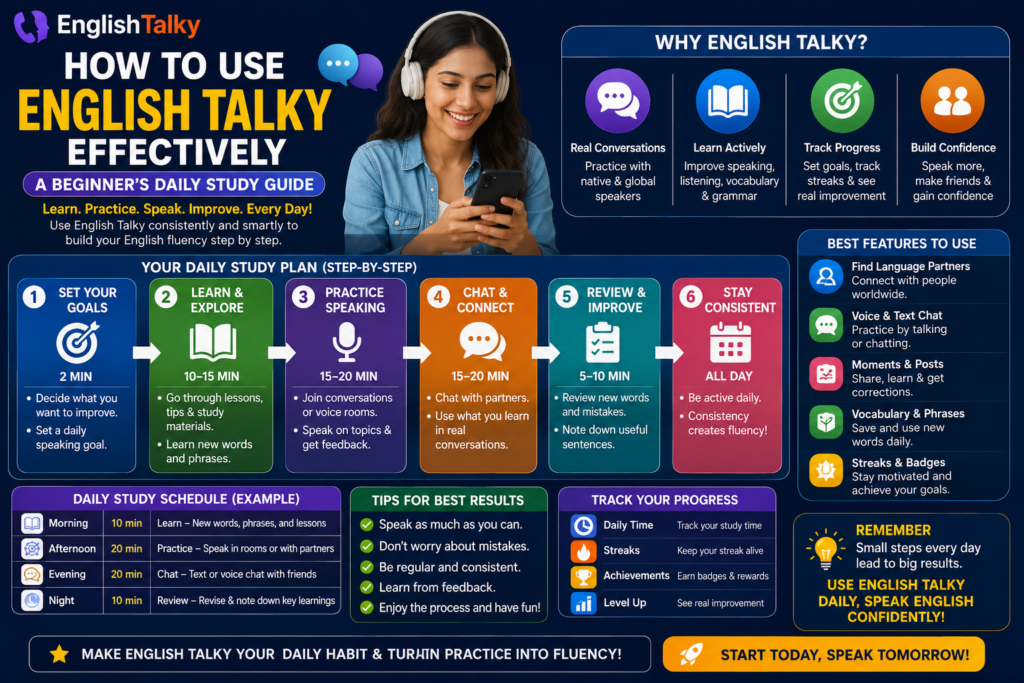
8. A Simple Daily Routine for Beginners
Here’s a realistic daily plan you can follow.
Daily English Talky Routine (15–20 Minutes)
Before the Call (2 minutes)
- Wear headphones
- Open English Talky
- Pick your comfort setting
During the Call (10–15 minutes)
- Greet politely
- Speak slowly and clearly
- Ask simple questions
- Listen actively
After the Call (2–3 minutes)
- Rate the experience
- Note one new word or phrase
- Smile—you practiced today
That’s it.
No books.
No stress.
Just real progress.
9. Summary Checklist for Beginners
Use this checklist to stay on track:
- ☐ Practice at least 15 minutes daily
- ☐ Use headphones for better focus
- ☐ Accept mistakes as learning tools
- ☐ Try different partners and accents
- ☐ Use the rating system responsibly
- ☐ Track small wins, not perfection
Final Words: Your First “Hello” Is Enough
You don’t need perfect grammar to begin.
You don’t need a large vocabulary to be understood.
You don’t need confidence before you start speaking.
These are things that grow with practice, not requirements you must meet in advance.
Many learners wait for the “right time” to speak English—when they know more words, when their pronunciation improves, or when they feel less nervous. But that perfect moment never comes. What does come is progress when you take small, imperfect steps every day.
Confidence is not something you prepare first and then use.
Confidence is something you build by speaking.
Every short conversation strengthens your listening skills.
Every mistake trains your brain.
Every awkward pause teaches you how to respond better next time.
With regular practice on English Talky, speaking English slowly stops feeling scary and starts feeling natural. What once caused anxiety becomes routine. What once felt impossible becomes familiar.
Your journey to fluent, confident English doesn’t require courage for a long speech or a perfect introduction. It begins with a single tap on your screen—and one simple word spoken out loud:
“Hello.”
Say it today.
Say it imperfectly.
Say it again tomorrow.
That’s how fluency begins.