
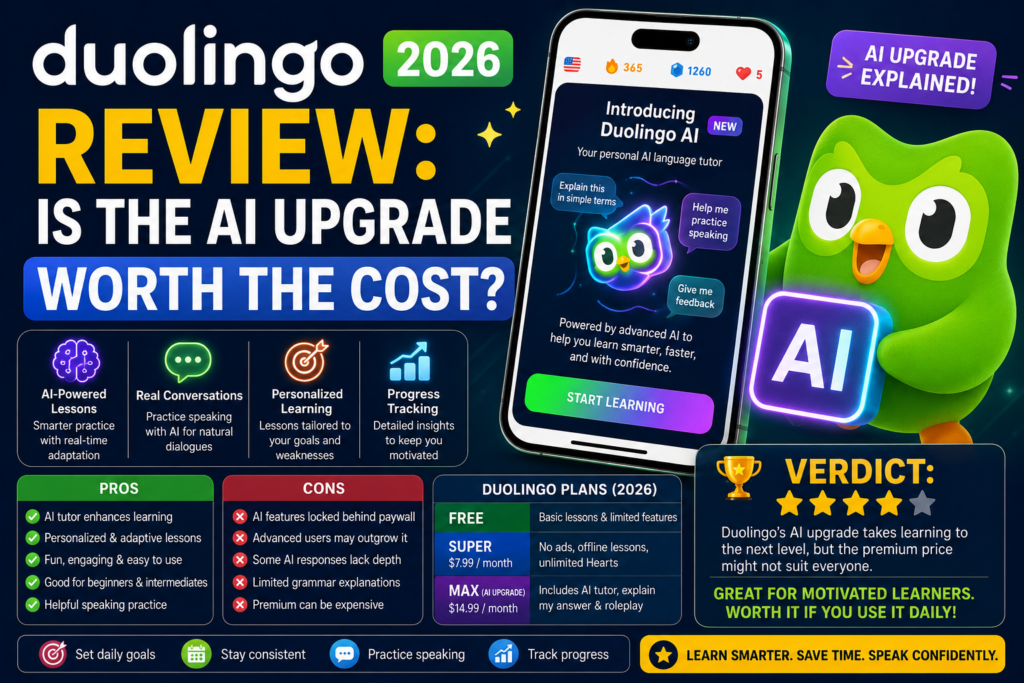
In 2026, the question is no longer “Have you heard of Duolingo?” but rather, “Is Duolingo actually helping you speak?”
With over 500 million downloads and a cultural footprint that includes a menacingly motivational green owl, Duolingo has transitioned from a simple translation app into a global education juggernaut. But as the platform incorporates more generative AI and pushes users toward higher-tier subscriptions like Duolingo Max, it is time for a deep dive.
This is the definitive 2026 review of Duolingo for englishtalky.com. We’ll explore whether the “gamified” approach to language learning still holds up, how the new AI features change the game, and if you can truly reach fluency by tapping on your phone for fifteen minutes a day.
1. The Duolingo Philosophy: Habit Over Hardship
The core of Duolingo’s success isn’t necessarily its linguistics; it’s its psychology. In 2026, the app remains the gold standard for “low-friction” learning.
The Power of the Streak
The “Streak” is the heartbeat of the app. By rewarding users for consecutive days of use, Duolingo solves the biggest hurdle in language acquisition: dropout rates. While traditional methods (textbooks, evening classes) often feel like a chore, Duolingo feels like a game.
- Gamification: XP points, Lingots (now Gems), and weekly Leaderboards turn learning into a social competition.
- Bite-sized Lessons: Most lessons take 3–5 minutes. This makes it possible to learn while waiting for coffee or commuting.
The 2026 Interface
The “Learning Path” (introduced a few years ago) has been further refined. It is a linear, guided journey that removes “choice paralysis.” You don’t have to decide what to study; you just click the next circle on the path. For beginners, this structure is a godsend.
2. New for 2026: The AI Revolution
The most significant change in the last year has been the full integration of GPT-4o and proprietary AI models into the curriculum. This has birthed the Duolingo Max tier.
Video Call with Lily
One of the most requested features in the history of the app was “real speaking practice.” In 2026, Max subscribers can engage in Video Calls with Lily, the app’s resident cynical teenager.
- How it works: You have a real-time, simulated video chat. Lily reacts to your voice, corrects your grammar on the fly, and adapts the conversation based on your level.
- The Verdict: It’s impressively fluid. Unlike the scripted “chatbots” of 2024, the 2026 AI feels spontaneous. However, it is currently limited to major languages (Spanish, French, English, German).
Explain My Answer
Ever wondered why you were wrong? Previously, Duolingo’s lack of grammar explanations was its biggest flaw. Now, the “Explain My Answer” feature—powered by AI—provides a personalized breakdown of your mistakes.
Note: As of early 2026, “Explain My Answer” has started rolling out to some Free and Super users, though the most detailed linguistic breakdowns remain a Max exclusive.
3. The Subscription Tiers: What’s the Cost?
Duolingo remains “Free,” but the experience varies wildly depending on your wallet.
| Feature | Free | Super Duolingo | Duolingo Max |
| Ads | Yes | No | No |
| Hearts (Lives) | Limited (5) | Unlimited | Unlimited |
| Personalized Review | Basic | Advanced | Full AI-Integration |
| AI Roleplay | No | No | Yes |
| Video Calls | No | No | Yes |
| Price (Estimated) | $0 | ~$12.99/mo | ~$29.99/mo |
Is it worth it?
If you are a casual learner, the Free version is still viable, though the Heart system (where you lose a life for every mistake) can be frustrating. Super Duolingo is the “sweet spot” for most, removing ads and the stress of failing. Duolingo Max is for those who are serious about speaking and have the budget for a premium AI tutor.
4. The “Fluency” Debate: Can You Actually Speak?
We need to be honest: Duolingo will not make you “fluent” on its own.
The Strength: Recognition and Vocabulary
Duolingo is world-class at teaching you to recognize words. Because of the constant repetition and visual cues, you will build a massive mental library of vocabulary. By the time you finish a Spanish or French path, you will likely be at a B1 or B2 level in reading and listening comprehension.
The Weakness: Production and Spontaneity
The app’s biggest hurdle is production—the ability to form your own sentences from scratch without a word bank.
- The “Translation Trap”: Most exercises involve translating into English or picking words from a list. This doesn’t train your brain to “think” in the target language.
- Lack of Depth: While the AI Video Calls are helping, the majority of the app is still focused on isolated sentences. You might know how to say “The bear eats the apple,” but can you argue about politics or explain a complex medical symptom? Likely not.
5. Pros and Cons: At a Glance
Pros
- Addictive in a Good Way: The streak system actually works to keep you coming back.
- Extensive Language Catalog: From Spanish and Japanese to High Valyrian and Klingon.
- High-Quality Audio: The voice acting and text-to-speech are now indistinguishable from native speakers.
- Accessibility: You can learn anywhere, anytime.
Cons
- The “Heart” System: Punishing users for making mistakes is counter-intuitive to language learning science.
- Subscription Creep: The best features are increasingly locked behind the expensive Max tier.
- Implicit Grammar: The app still relies heavily on you “figuring it out” rather than explaining rules clearly.
6. Duolingo vs. The Competition (2026)
How does the green owl stack up against the other big players in 2026?
- Babbel: Still the better choice for “serious” learners who want structured, classroom-style grammar lessons.
- Rosetta Stone: Focuses more on “immersion” (no English translations), which is better for some but slower for others.
- Pimsleur: If your goal is only speaking, Pimsleur’s audio-based method still outperforms Duolingo’s app-based drills.
- Memrise: Excellent for slang and “real-world” video clips of native speakers, though its UI is less polished.
7. Maximizing Your Learning: The EnglishTalky Strategy
If you want to use Duolingo effectively in 2026, don’t use it in a vacuum. Here is our recommended “Power Routine”:
- The 15-Minute Rule: Do two lessons on Duolingo every morning to keep your “brain” in the language.
- Supplement with Input: Watch one YouTube video or listen to one podcast in your target language daily. Duolingo provides the bricks (vocab), but you need to see the house (real conversation).
- Use the AI: If you have Max, use the Video Call feature for at least 10 minutes a week. Force yourself to make mistakes.
- Disable the Word Bank: On the mobile app, whenever possible, switch to the “Keyboard” mode. Typing the words yourself is 10x more effective than clicking on them.
8. Final Verdict: 4.5/5 Stars
In 2026, Duolingo remains the best entry point for any language learner. Its ability to turn a daunting task into a fun, daily habit is unparalleled.
While it still struggles to take learners into the “Advanced” (C1/C2) territory, the 2026 AI updates have closed the gap significantly for intermediate speakers. It is no longer just a “game”—with the right subscription and a bit of outside supplement, it is a legitimate path to conversational proficiency.
Who is this for?
- Absolute Beginners: It is the best way to start from zero.
- Hobbyists: People who want to keep their brain sharp without the pressure of a class.
- Travelers: Perfect for picking up the “Survival” basics before a trip.
Who should skip it?
- Advanced Learners: If you already speak at a B2 level, Duolingo will feel like a waste of time.
- Grammar Purists: If you need to know the why of every conjugation immediately, the “figure it out” style will frustrate you.
[…] 2. Duolingo […]