
Updated on 12-04-2026
In a world that’s increasingly global and interconnected, English speaking skills are no longer optional — they are essential. Whether you’re preparing for a job interview, improving academic communication, or pursuing international opportunities, a strong command of spoken English can be a game-changer.
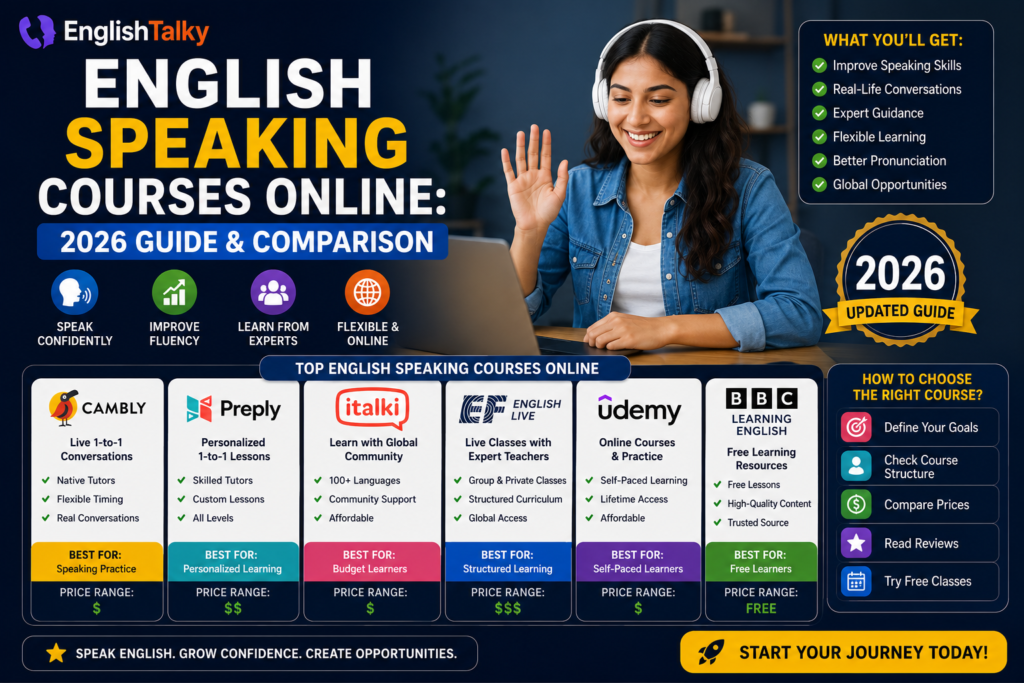
With so many English speaking course online options available today, choosing the right one can be confusing. Some focus on pronunciation, others on fluency, some are free, while others are premium, and a few offer certificates. This guide breaks down the best online English speaking courses, compares their features, and helps you decide which one is ideal for you.
Why Learn English Online?
To truly understand the shift toward digital learning in 2026, we have to look beyond just “convenience.” The expansion of online English courses has redefined the classroom from a physical space into a personalized, high-performance ecosystem.
Here is an expanded look at why learning English online has become the global standard:
Accessibility: The End of Geographic Barriers
In 2026, quality education is no longer determined by your zip code.
- Global Expertise: You can learn from a native speaker in London or a career coach in New York while sitting in a cafe in Kerala. You are no longer limited to the “best teacher in town,” but the best teacher in the world.
- Inclusion for All: Online platforms have become a lifeline for stay-at-home parents, individuals with physical disabilities, or those living in rural areas where high-quality English institutes are scarce.
- Learning on the Move: With 5G and seamless mobile integration, “dead time”—like sitting on a bus or waiting in line—becomes a productive 15-minute speaking session.
Flexibility: Learning that Fits Your Life
Traditional classes force you to mold your life around a schedule; online learning molds the schedule around you.
- Self-Paced Mastery: Unlike a physical classroom where the teacher moves on once the majority understands, online tools allow you to replay a difficult pronunciation lesson ten times or skip past a grammar rule you’ve already mastered.
- Asynchronous Options: You can engage in “live” practice when you have energy, or use AI-driven tools at 2:00 AM if that’s when your brain is most active.
- Consistency over Intensity: Research shows that 15 minutes of daily online practice is more effective for fluency than a grueling 3-hour weekend marathon in a physical center.
Cost Efficiency: High Value, Low Overhead
Online learning has significantly lowered the “entry fee” for fluency.
- Elimination of “Hidden” Costs: When you learn online, you save on commuting fares, fuel, parking, and expensive physical textbooks.
- Competitive Pricing: The global market for online English learning—valued at over $100 billion in 2026—has driven prices down. You can now access premium 1:1 tutoring for a fraction of the cost of a private local tutor.
- Scalable Resources: Most online courses include free digital libraries, AI feedback tools, and recorded sessions that you can keep forever—value that a one-time physical lecture cannot match.
Psychological Comfort: The “Anxiety-Free” Zone
One of the most overlooked benefits of online learning is the reduction of Foreign Language Anxiety.
- Safe Space to Fail: Making mistakes is essential for learning. Many students feel more comfortable “messing up” in a 1:1 online chat or with an AI bot than in front of a room full of peers.
- Audio-Only Advantage: Platforms that offer audio-only sessions allow learners to focus entirely on their speech and listening skills without the added pressure of maintaining eye contact or worrying about their appearance on camera. This “invisible” practice builds a foundation of confidence that eventually translates to real-world face-to-face success.
Types of English Speaking Courses Online
There are generally four broad categories of online courses:
- Free Self-Guided Courses – These are best for beginners or casual learners.
- Structured MOOCs and Certificates – Ideal for serious learners who want badges or proof of completion.
- AI-Powered Pronunciation and Practice Tools – For accent, clarity, and feedback.
- Live Tutoring / Conversation Practice – Best for real-life fluency and interactive learning.
Let’s explore each in detail.
Free English Speaking Courses
For beginners and budget learners, free courses provide a great starting point.
1. BBC Learning English
BBC offers comprehensive video and audio lessons that cover vocabulary, pronunciation, and real dialogues — all without signup. It’s excellent for intermediate learners who want structured grammar and speaking exercises from a reputable source.
Best for: Beginners to intermediate learners
Strengths: Free, structured lessons, real-world authentic content
Limitations: No certificates
2. Duolingo
Duolingo’s gamified format makes learning fun. It’s not specifically a speaking course, but its bite-sized lessons improve vocabulary and basic sentence formation — an important foundation for speaking.
Best for: Beginners, daily practice
Strengths: Fun, free, app-based
Limitations: Limited real-conversation practice
3. Alison
Alison offers free online English courses with certificates. Some cover basic speaking and everyday conversations. It’s best for learners who want official recognition for their efforts at no cost.
Best for: Learners who value certificates
Strengths: Free + certificate
Limitations: Self-paced, limited speaking feedback
4. USA Learns
USA Learns offers beginner and intermediate English skills training, including listening and speaking practice. This platform is sponsored by the U.S. government and designed to be easy for adult learners.
Best for: Absolute beginners
Strengths: Free, voice recording practice available
Limitations: Less advanced speaking support
Structured Online English Courses
These are comprehensive learning options often offered by universities or expert educators, usually with certificates.
Coursera English Courses
Coursera hosts several English courses like “Speak English Professionally” and “Improve Your English Communication Skills.” These combine grammar, speaking practice, and professional communication. Certificates are available upon completion.
Best for: Learners seeking credibility and structured career learning
Strengths: University-level curriculum, certificates
Limitations: Some require subscription fees
EdX Conversational English
EdX offers conversational courses that focus on fluency and real usage in daily scenarios. These courses are self-paced and often provide a certificate for a small fee.
Best for: Intermediate learners
Strengths: High-quality instruction, flexibility
Limitations: Paid certificates
Udemy Spoken English Courses
Udemy has hundreds of English speaking courses, from beginner to advanced levels. These usually come with video lessons, quizzes, and lifetime access. Prices vary but often go on sale.
Best for: Self-learners
Strengths: Affordable, lifetime access
Limitations: Quality varies by instructor
AI-Powered and Interactive English Speaking Tools
AI and technology have transformed how we learn and practice English. These tools focus specifically on speaking, fluency, and pronunciation.
ELSA Speak
ELSA (English Language Speech Assistant) is an AI-powered app that listens to your speech and gives instant detailed feedback on pronunciation and fluency. Because its technology is trained on diverse accents, it recognizes non-native speech better than many traditional tools.
Best for: Pronunciation improvement and accent reduction
Strengths: Real-time AI feedback
Limitations: Not a complete conversation platform
Xeropan
Xeropan uses a gamified approach to language learning. It includes videos, vocabulary drills, and AI bots that simulate conversation practice, helping learners build confidence.
Best for: Learners who enjoy interactive lessons
Strengths: AI speakbots, gamified lessons
Limitations: Less structured than traditional courses
Live English Speaking Practice Platforms
Live interaction with real tutors or native speakers is often considered the fastest path to fluency.
Cambly
Cambly connects learners to native English tutors for 1-on-1 sessions over video chat. It’s ideal for real conversational practice and instant feedback, especially for advanced learners.
Best for: Real conversations and fluency building
Strengths: Native speaker interaction
Limitations: Can be expensive
Speechify
Speechify provides one-on-one conversation sessions with experienced tutors and helps learners improve speaking skills through targeted practice.
Best for: Personalized speaking improvement
Strengths: Real-time tutor feedback
Limitations: Cost varies by tutor
Live Group Classes (e.g., Lingoda)
Platforms like Lingoda offer structured levels (A1 to C1) in small group or individual classes, combining schedule discipline with speaking practice. Many offer free trial classes.
Best for: Learners who want structured class rhythm
Strengths: Certified instructors
Limitations: Requires commitment
Comparing Popular English Speaking Courses Online
Here’s a snapshot of how these courses stack up:
| Platform | Best For | Structure | Certificate | Cost |
|---|---|---|---|---|
| BBC Learning English | Free structured lessons | Self-guided | No | Free |
| Duolingo | Beginners | Gamified | No | Free |
| Coursera | Career-focused English | Structured | Yes | Free + paid |
| Udemy Courses | Flexible learners | Video lessons | Yes | Paid (affordable) |
| ELSA Speak | Pronunciation | Interactive | No | Freemium |
| Xeropan | Interactive speaking | Gamified | No | Freemium |
| Cambly | Real conversations | 1-on-1 live | No | Paid |
| Lingoda | Structured speaking | Live classes | Yes | Paid |
How to Choose the Best English Speaking Course Online
With so many options, how do you decide? Here are some criteria:
1. Your Current Level
- Beginner? Start with free structured lessons like BBC, Duolingo, or Alison.
- Intermediate? Coursera and EdX help build confidence.
- Advanced? Cambly or Lingoda provide fluency through conversation.
2. Time Commitment
- Busy schedules? Self-paced courses (Udemy, Duolingo) are ideal.
- Consistent learning? Live classes are best.
3. Goal of Learning
- Pronunciation focus – ELSA Speak.
- Real conversation – Cambly or Speechify.
- Certification – Coursera or Lingoda.
Tips to Maximize Your Online English Learning
To gain fluency in 2026, it’s not about how long you study, but how smart you integrate English into your subconscious. Here is an expanded look at how to maximize your progress using modern techniques and technology.
Practice Speaking Daily (The “Consistency” Rule)
Fluency is a muscle that atrophies without use.
- The 15-Minute Rule: Even on your busiest days, commit to 15 minutes of vocalizing. This keeps your mouth muscles accustomed to English phonemes.
- Narrate Your Life: If you don’t have a partner, talk to yourself. Describe what you are cooking, your plans for the day, or your reaction to a news story.
- Low-Stakes Practice: Use audio-only platforms to practice speaking without the “visual pressure” of a camera. This lowers your performance anxiety and allows you to focus purely on word retrieval.
Use Multimedia Tools (Active vs. Passive Immersion)
Passive listening isn’t enough; you need “Active Immersion.”
- The “No Subtitles” Challenge: Watch a 10-minute YouTube clip or a Netflix scene without subtitles. Then, watch it again with English subtitles to see what you missed. Never use subtitles in your native language.
- Podcast Variety: Listen to “Natural Speech” podcasts rather than just educational ones. This exposes you to fillers (like “um,” “you know,” “actually”), slang, and the rhythmic “intonation” of real conversation.
- Interactive Content: Engage with interactive AI videos where you have to respond to prompts to move the story forward.
The Shadowing Method (The Secret to Native Rhythm)
Shadowing is the most effective way to improve your accent and “prosody” (the melody of the language).
- Listen and Mimic: Listen to a short audio clip and repeat it at the same time as the speaker. Don’t wait for them to finish; try to stay just a split second behind them.
- Focus on Emotion: Don’t just mimic the words—mimic the speaker’s emotion, pauses, and where they place emphasis.
- Record and Compare: Record yourself shadowing a native speaker, then play it back alongside the original. You will immediately hear the subtle differences in your vowel sounds or sentence stress.
Join Language Communities (The Social Catalyst)
Language is social by nature. Isolation is the enemy of fluency.
- Peer-to-Peer Exchange: Join platforms where you can talk to other learners. Often, speaking with another non-native speaker is less intimidating and helps you practice “negotiation of meaning”—finding different ways to explain a word you’ve forgotten.
- Niche Forums: Join an English-speaking community centered around a hobby you love (like coding, photography, or football). When you focus on the topic rather than the grammar, your fluency increases naturally.
- Micro-Communities: Look for “Speaking Clubs” or WhatsApp/Telegram groups that host 20-minute daily voice-note challenges.
Leverage AI Feedback (The 2026 Edge)
In 2026, you have a private tutor in your pocket.
- Instant Corrections: Use AI tools to transcribe your speech. If the AI can’t understand what you said, a human probably won’t either. It’s a perfect, objective test of your clarity.
- Roleplay Scenarios: Use AI chatbots to simulate specific high-pressure situations—like a salary negotiation or a medical appointment—before you do them in real life.
Pro Tip: Combine these! Watch a 5-minute video (Multimedia), shadow the main character (Shadowing), then jump onto a 10-minute audio call (Speaking Daily) to discuss the video with a peer (Community).
Final Recommendations
Here’s a quick strategy based on goals:
Beginners
Start with BBC Learning English, Duolingo, or Alison to build basics.
Intermediate Learners
Enroll in Coursera or Udemy courses for deeper, structured learning.
Pronunciation Boost
Use ELSA Speak daily in short sessions.
Fluency & Conversation
Invest in Cambly, Speechify, or Lingoda for live interaction.
Conclusion
Today’s educational landscape offers an unprecedented variety of English speaking course online options. From free platforms like BBC Learning English and Duolingo to structured, paid courses on Coursera and Udemy — and from AI tools like ELSA Speak to live tutor platforms like Cambly — there’s something for every learner.
The best results usually come from combining tools — using technology for guided learning and real conversations for practice. With consistent effort and the right platform aligned to your goals, fluency in English speaking is not just possible — it’s achievable.