
Learning English is easier when you actually use it.
You can study grammar rules, memorize vocabulary, watch English movies, read books, and complete hundreds of exercises. All of these activities can help. But there is one thing that is difficult to replace: speaking with another person in real time.
Many English learners understand what other people say in English but struggle when it is their turn to speak. They may know the right words but cannot form sentences quickly. They may feel nervous about making mistakes. Sometimes, they simply do not have anyone around them with whom they can practice English regularly.
This is where an English speaking app with real people can make a difference.
Instead of only learning English from lessons or exercises, you can use an app to have actual conversations with other people. You get the opportunity to listen, respond, ask questions, explain your ideas, and communicate naturally.
For many learners, this is the kind of practice they have been looking for.
Why Speaking English Is Different from Studying English
There is a big difference between knowing English and using English.
You might know that the past tense of “go” is “went.” You might understand the difference between “has” and “have.” You might even know hundreds or thousands of English words.
But when someone suddenly asks you:
“What did you do yesterday?”
you have to respond immediately.
There is no time to open a grammar book and search for the correct structure.
You need to think, choose words, form a sentence, and speak.
That ability develops through practice.
This is why real conversations are so useful. They put you in situations where you have to use the English you already know. With regular practice, speaking can gradually become more natural and automatic.
What Is an English Speaking App with Real People?
An English speaking app with real people connects English learners with other people for live conversations.
Depending on the app, these conversations may be one-to-one calls, group discussions, language exchange sessions, or topic-based conversations.
The important difference is that you are communicating with real people rather than only interacting with an automated lesson.
For example, you might start a conversation with someone from another country and introduce yourself.
You could talk about:
- Your hometown
- Your job or studies
- Your hobbies
- Food
- Travel
- Movies
- Daily routines
- Sports
- Technology
- Family
- Books
- Future plans
The conversation does not always need to follow a lesson plan. In fact, the unpredictable nature of real conversations can be one of the most useful parts of the experience.
You never know exactly what the other person is going to say.
And that is how real communication works.
Why Talking to Real People Helps
One of the biggest advantages of talking to real people is that you have to react naturally.
A textbook exercise might give you a sentence such as:
“What is your favorite hobby?”
You choose an answer and move to the next question.
A real person may ask:
“Why do you like photography?”
Then:
“When did you start taking photos?”
Then:
“Do you use your phone or a camera?”
Suddenly, the conversation has moved in a completely different direction.
You have to listen carefully and respond.
This kind of interaction helps develop several important communication skills at the same time.
1. Listening
Speaking practice is also listening practice.
When you regularly talk with different people, you hear different accents, speaking speeds, vocabulary choices, and ways of expressing ideas.
This can gradually make it easier to understand English outside the classroom.
2. Quick Thinking
During a live conversation, you cannot spend several minutes preparing every sentence.
You have to think in English and respond.
At first, this can feel difficult. But repeated practice can make the process faster.
3. Vocabulary in Context
Memorizing a word is one thing. Using it naturally is another.
Real conversations give you opportunities to use new words in meaningful situations.
For example, learning the word “exhausted” is useful. But using it naturally in a conversation such as:
“I was exhausted after work yesterday.”
helps you understand how the word actually works.
4. Confidence
Many learners are afraid of making mistakes.
They may think:
“What if my grammar is wrong?”
“What if I forget a word?”
“What if the other person laughs at me?”
The more you speak, the more familiar these situations become.
You gradually realize that communication does not require perfect English.
The goal is to express your meaning and understand the other person.
You Do Not Need Perfect English Before You Start
A common mistake among English learners is waiting until their English becomes “good enough” before speaking.
But how does speaking improve if you never speak?
You do not need perfect grammar to begin.
You can start with simple sentences.
For example:
“My name is Rahul. I live in Kerala. I am learning English because I want to speak more confidently.”
That is enough to start a conversation.
As you continue talking, you will discover the areas where you need improvement.
Maybe you frequently use the wrong tense. Maybe you have difficulty describing past events. Maybe you understand questions but cannot answer quickly.
These are useful discoveries because they show you what to practice next.
Why Conversations with Strangers Can Be Useful
Talking to someone you already know can sometimes feel comfortable. But it can also become predictable.
Your friends and family already know your background. You may use the same expressions and discuss the same topics.
Talking to a new person creates a different experience.
You have to introduce yourself.
You have to explain things that the other person does not know.
You may need to ask questions to keep the conversation going.
For example:
“Where are you from?”
“What do you do?”
“What is your city like?”
“What kind of food do you like?”
“What do people usually do there on weekends?”
These simple questions are actually excellent English-speaking practice.
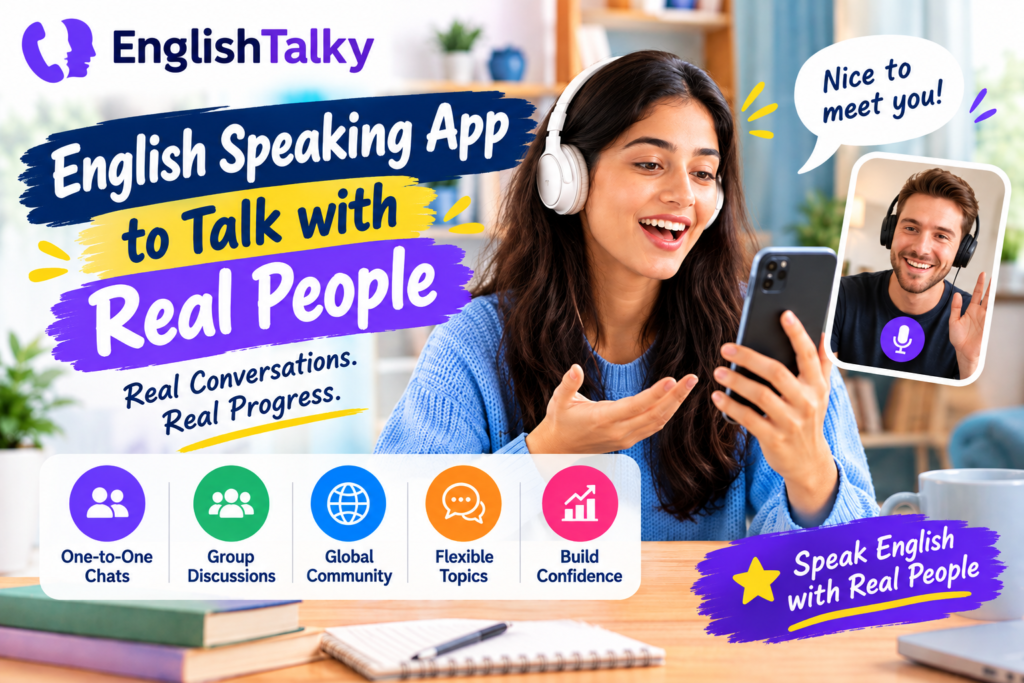
EnglishTalky: Practice Speaking with Real People
EnglishTalky is designed around the idea that English speaking improves through actual communication.
Instead of only completing lessons, learners can use EnglishTalky to have live conversations with real people.
The experience is centered around speaking rather than simply reading or typing.
You can connect with another person, start talking, and practice English naturally.
One conversation may be about travel. Another might be about work. The next could be about movies, food, education, hobbies, or everyday life.
Every conversation gives you another opportunity to use English.
And because you are talking to different people, every conversation can feel different.
What If You Make Mistakes?
You will make mistakes.
That is normal.
If you are learning to speak English, mistakes are not evidence that you should stop speaking. They are part of the learning process.
Suppose you say:
“Yesterday I go to the market.”
The correct sentence is:
“Yesterday I went to the market.”
The mistake gives you something to remember.
Later, when you want to talk about yesterday, you may naturally remember:
“Yesterday I went…”
This is one reason practical conversation can complement traditional English lessons.
You are not just learning rules. You are discovering how those rules work while communicating.
How to Get More from an English Speaking App
Simply installing an app is not enough. The way you use it matters.
Here are a few habits that can make your practice more useful.
Speak Regularly
Ten or fifteen minutes of speaking practice every day can be more useful than having one long conversation once a month.
Try to make speaking part of your routine.
Do Not Prepare Every Sentence
It is fine to think before answering, but try not to translate every sentence from your native language into English.
Start with simple English and gradually learn to think directly in English.
Ask Questions
A good conversation is not just about answering questions.
Ask the other person questions too.
If someone says:
“I work in a hospital.”
you can ask:
“What do you do there?”
or:
“How long have you been working there?”
This keeps the conversation moving and gives you more speaking practice.
Try Different Topics
Do not always talk about the same subject.
Talk about your daily life one day. Discuss travel another day. Try technology, food, sports, education, movies, or future plans.
Different topics expose you to different vocabulary.
Focus on Communication, Not Perfection
If you stop every few seconds to worry about grammar, conversation can become stressful.
Try to communicate your idea first.
Accuracy can improve gradually with practice and feedback.
Real Conversations Can Prepare You for Real Life
English is rarely used in real life like a grammar exercise.
During a job interview, you may need to explain your experience.
During a trip, you may need to ask for directions.
At work, you may need to participate in a meeting.
When meeting someone new, you may need to introduce yourself.
During an online conversation, you may have to explain an opinion.
These situations require more than vocabulary.
They require the ability to listen, think, respond, and continue the conversation.
Regular conversations can help you become more comfortable with these skills.
Speaking English Does Not Have to Feel Like Studying
One of the interesting things about conversation-based learning is that it does not always feel like studying.
You can simply talk.
You might laugh about something that happened during the day. You might discover an interesting fact about another person’s country. You might discuss a movie you watched recently.
At the same time, you are practicing English.
That combination can make regular practice easier to maintain.
Instead of thinking, “I need to study English for one hour,” you can think, “I am going to have an English conversation today.”
That small change in mindset can make speaking practice feel much more approachable.
Start Speaking Before You Feel Ready
If you are waiting until your English is perfect before having real conversations, you may be waiting for a long time.
Speaking ability develops through speaking.
You will make mistakes. You will sometimes forget words. There will be moments when you do not understand what someone says. Occasionally, you may not know what to talk about.
All of that is part of learning.
The important thing is to keep practicing.
An English speaking app with real people can give you something that books, videos, and grammar exercises cannot completely provide: the experience of actually communicating with another person in English.
With EnglishTalky, the idea is simple: connect with real people, start a conversation, and practice speaking English.
You do not need to wait until you become fluent.
Start with the English you have today.
Every conversation is another chance to become a little more comfortable, a little more confident, and a little better at expressing yourself in English.