
Speaking is one of the most important communication skills in life. Whether you are attending a job interview, participating in a classroom discussion, talking to friends, giving a presentation, or communicating with customers, your speaking ability plays a major role in how others understand you.
Many people think speaking English means only knowing grammar and vocabulary. In reality, good speaking involves several smaller skills working together. Some people know many English words but still struggle to speak confidently. Others speak fluently but fail to communicate clearly because they lack pronunciation or listening skills.
To become a strong English speaker, it is important to understand the core speaking skills that shape effective communication. These skills can be practiced and improved over time with regular effort.
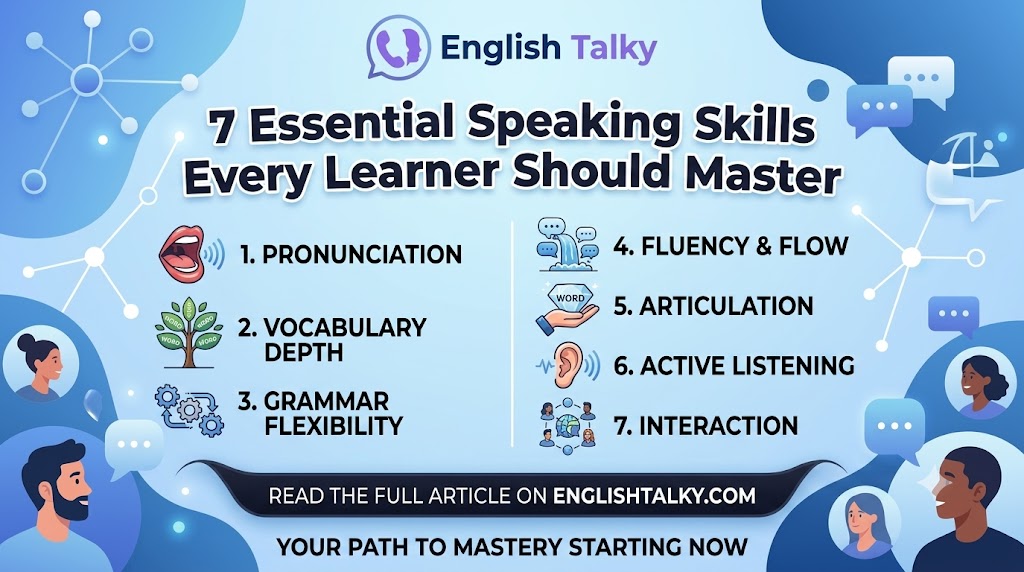
In this article, we will explore the 7 essential speaking skills and understand why each one matters.
1. Pronunciation
Pronunciation is the way words are spoken. It includes the correct sounds, stress patterns, and intonation used while speaking.
Good pronunciation helps listeners understand you clearly. Even if your grammar is not perfect, clear pronunciation can make communication easier. On the other hand, poor pronunciation may confuse listeners, even when your sentence structure is correct.
For example:
- “Ship” and “sheep” sound similar but have different meanings.
- “Desert” and “dessert” are also pronounced differently.
Correct pronunciation is not about copying a foreign accent perfectly. You do not need an American or British accent to speak good English. The main goal is clarity.
How to Improve Pronunciation
- Listen to native and fluent speakers regularly.
- Practice repeating words aloud.
- Use online dictionaries with audio pronunciation.
- Record your voice and compare it.
- Focus on difficult sounds individually.
Watching English movies, listening to podcasts, and practicing conversations daily can also help improve pronunciation naturally.
2. Vocabulary
Vocabulary refers to the words you know and use while speaking.
A strong vocabulary allows you to express your thoughts clearly and accurately. If you know only a few words, conversations become difficult because you cannot explain ideas properly.
For example, instead of saying:
- “The movie was good,”
a better vocabulary helps you say:
- “The movie was inspiring,”
- “The movie was emotional,”
- “The movie was entertaining.”
The more words you know, the more confidently you can speak.
However, vocabulary building is not about memorizing difficult words. It is about learning useful everyday words and knowing how to use them naturally.
How to Improve Vocabulary
- Read English books, blogs, and articles.
- Learn words in sentences, not alone.
- Practice speaking using new words.
- Maintain a vocabulary notebook.
- Learn phrases and expressions commonly used in conversations.
It is also useful to learn topic-based vocabulary such as travel words, workplace vocabulary, food-related terms, and emotional expressions.
3. Grammar
Grammar is the structure of a language. It helps organize words correctly to form meaningful sentences.
Many learners fear grammar because they think every sentence must be perfect before speaking. This fear often stops them from practicing.
The truth is that communication matters more than perfection.
Still, grammar is important because it helps listeners understand your meaning correctly.
Compare these two sentences:
- “I go yesterday.”
- “I went yesterday.”
The second sentence is grammatically correct and easier to understand.
Good grammar improves accuracy and professionalism, especially in formal situations such as interviews, meetings, presentations, and exams.
How to Improve Grammar for Speaking
- Learn basic sentence structures first.
- Practice common tenses daily.
- Focus on speaking simple correct sentences.
- Avoid memorizing complicated grammar rules unnecessarily.
- Use grammar naturally during conversations.
Remember that spoken English is often simpler than written English. Start with basic grammar and improve gradually through regular speaking practice.
4. Fluency
Fluency is the ability to speak smoothly without too many pauses or hesitation.
Many English learners know grammar and vocabulary but struggle to speak continuously. They stop frequently to think about words or grammar rules.
Fluent speakers do not necessarily speak fast. They speak naturally and comfortably.
Fluency develops mainly through practice, not through theory alone.
For example, a learner may understand English very well while reading or listening, but when speaking, they hesitate because they lack real conversation experience.
How to Improve Fluency
- Speak English daily.
- Think in English instead of translating from your native language.
- Practice speaking on random topics for 1–2 minutes.
- Join conversation groups.
- Avoid overthinking grammar while speaking.
One of the best ways to improve fluency is through consistent speaking practice with real people. Platforms like EnglishTalky can provide learners with opportunities to practice spoken English regularly in a comfortable environment without pressure.
The more you speak, the more natural your fluency becomes.
5. Listening Skills
Speaking and listening are deeply connected. Good speakers are usually good listeners.
Listening helps you:
- understand conversations,
- respond correctly,
- learn pronunciation,
- improve vocabulary,
- notice sentence patterns.
If you do not understand what others are saying, communication becomes difficult.
Many learners focus only on speaking practice and ignore listening. But listening is one of the fastest ways to improve spoken English naturally.
Children learn language first by listening, then by speaking. English learners can benefit from the same approach.
How to Improve Listening Skills
- Listen to English podcasts.
- Watch English videos with subtitles.
- Listen actively instead of passively.
- Repeat sentences after speakers.
- Practice understanding different accents.
At first, you may not understand everything. That is normal. Over time, your ears become trained to recognize English sounds more easily.
Regular listening improves both comprehension and speaking confidence.
6. Confidence
Confidence is one of the most important speaking skills.
Many learners know English but hesitate to speak because they fear making mistakes. This fear creates nervousness and reduces speaking ability.
Confidence does not mean speaking perfect English. It means being willing to communicate even when your English is not perfect.
Mistakes are a natural part of learning any language.
A confident learner:
- starts conversations,
- asks questions,
- practices regularly,
- learns from mistakes,
- improves faster.
On the other hand, learners who avoid speaking because of fear often progress slowly.
How to Build Confidence
- Practice speaking every day.
- Stop fearing mistakes.
- Speak slowly and clearly.
- Celebrate small improvements.
- Join supportive speaking communities.
Confidence grows through action. The more you speak, the less nervous you become.
Many English learners discover that regular practice with friendly speakers helps reduce fear and increase confidence significantly.
7. Non-Verbal Communication
Speaking is not only about words. Body language, facial expressions, eye contact, gestures, and tone of voice also play an important role in communication.
These are called non-verbal communication skills.
For example:
- Smiling makes conversations friendlier.
- Eye contact shows confidence.
- Proper hand gestures improve presentations.
- Voice tone expresses emotions.
Even in online conversations or video calls, non-verbal communication affects how people understand you.
A speaker with strong non-verbal communication appears more engaging and confident.
How to Improve Non-Verbal Communication
- Practice speaking in front of a mirror.
- Observe confident speakers.
- Maintain natural eye contact.
- Use simple gestures while speaking.
- Pay attention to your tone and expressions.
Your body language should support your message, not distract from it.
Why These 7 Speaking Skills Matter
All seven speaking skills work together.
For example:
- Vocabulary helps you find words.
- Grammar helps organize them.
- Pronunciation helps others understand them.
- Fluency helps you speak smoothly.
- Listening helps you respond correctly.
- Confidence helps you speak without fear.
- Non-verbal communication makes your speech more effective.
If one area is weak, communication may become difficult.
Imagine a learner with excellent grammar but poor confidence. They may still avoid speaking.
Or someone with good vocabulary but weak pronunciation may struggle to be understood.
Balanced improvement across all seven areas leads to strong speaking ability.
Common Mistakes English Learners Make
1. Focusing Only on Grammar
Many learners spend years studying grammar but rarely practice speaking.
Speaking improves mainly through active use, not only through studying rules.
2. Fear of Mistakes
Mistakes are necessary for improvement. Every fluent speaker once made mistakes too.
3. Translating Constantly
Thinking first in your native language slows down fluency.
Try to think directly in English.
4. Lack of Regular Practice
Speaking is a skill that improves with consistency. Practicing once a week is usually not enough.
5. Ignoring Listening Practice
Listening trains your brain to understand natural English conversations and improves speaking naturally.
Practical Daily Habits to Improve Speaking Skills
Here are some simple habits that can improve your English speaking skills over time:
Speak for 10 Minutes Daily
Choose any topic and speak continuously.
Read Aloud
Reading aloud improves pronunciation, fluency, and confidence.
Listen and Repeat
Imitate native speakers from videos or podcasts.
Learn Useful Phrases
Instead of memorizing isolated words, learn complete expressions.
Join English Conversations
Real communication gives the best improvement.
Record Yourself
Listening to your own speech helps identify mistakes.
Stay Consistent
Small daily practice is more effective than occasional long study sessions.
Can Anyone Become a Good English Speaker?
Yes.
Speaking English is a skill, not a talent that only a few people have.
Some people learn faster because they practice more often or use better learning methods. But anyone can improve with:
- regular practice,
- patience,
- consistency,
- exposure to English,
- willingness to communicate.
Fluent speakers are not born fluent. They become fluent through repeated practice over time.
Final Thoughts
The 7 speaking skills — pronunciation, vocabulary, grammar, fluency, listening, confidence, and non-verbal communication — form the foundation of effective communication in English.
Improving these skills does not happen overnight. It is a gradual process that requires patience and regular practice. The good news is that even small daily improvements can create major progress over time.
Do not wait until your English becomes “perfect” before speaking. Start speaking now, even with simple sentences.
Every conversation helps you grow.
The more you listen, speak, practice, and interact with others, the stronger your speaking skills will become. With consistent effort and the right environment, anyone can become a confident English speaker.