
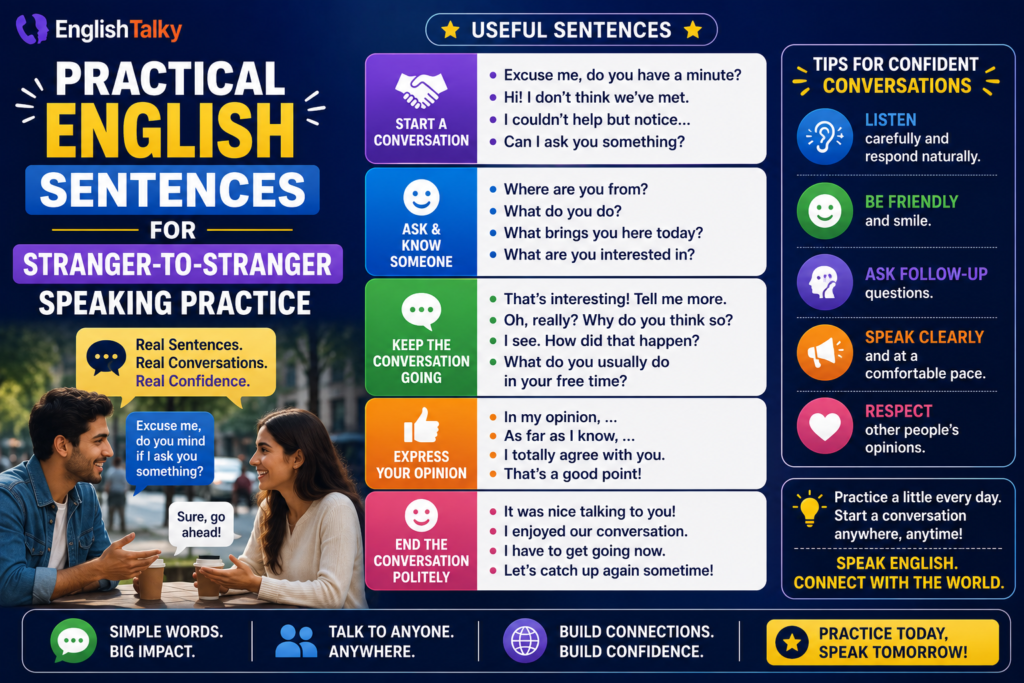
On EnglishTalky, every conversation connects you with a stranger from anywhere in the world. They could be a college student, working professional, job seeker, housewife, or senior. These dialogues focus on safe, neutral, and natural English sentences for audio-only practice.
1. Introducing Yourself to a Stranger
You: Hello! My name is Ajay. What’s your name?
Partner: Hi! I’m Maria. Nice to meet you.
You: Nice to meet you too. Are you a student or working?
Partner: I’m a teacher. And you?
You: I’m a student. Is this your first time using this platform?
Partner: Yes, I’m excited to practice English.
You: Me too! Let’s get started.
You: Where are you from?
Partner: I’m from Spain. And you?
You: I’m from India.
You: How did you hear about this platform?
Partner: A friend recommended it. How about you?
You: I found it online while looking for ways to improve my spoken English.
You: Do you usually practice English often?
Partner: Yes, I try to speak every day. It helps me feel more confident.
You: That’s smart! I try to practice whenever I get free time.
You: What do you hope to achieve by using this platform?
Partner: I want to improve my fluency and learn new phrases.
You: Same here! I also want to reduce my hesitation when speaking.
You: Do you prefer chatting with students or professionals?
Partner: I enjoy talking to everyone. Each conversation is different and interesting.
You: True! I like learning about other people’s experiences.
You: Do you find it easy to understand strangers’ accents?
Partner: Sometimes it’s a bit difficult, but I’m getting used to it.
You: I feel the same. Listening carefully helps a lot.
You: Do you enjoy talking about hobbies or work first?
Partner: Hobbies! It’s a fun way to start a conversation.
You: I agree. It makes chatting more relaxed.
You: Are you using this platform mostly for practice or for socializing too?
Partner: Mostly practice, but it’s nice to meet people from different countries.
You: Yes! I like learning about other cultures too.
You: How long have you been learning English?
Partner: About five years. You?
You: Around three years. I’m still improving.
You: What’s your favorite way to learn new words?
Partner: Reading books and watching movies. And you?
You: I like speaking with strangers—it helps me remember phrases better.
You: Do you feel nervous when talking to strangers online?
Partner: A little at first, but it gets easier with practice.
You: Same here! That’s why I like using this platform regularly.
You: Shall we set a goal for this conversation?
Partner: Sure! Maybe we can focus on fluency and pronunciation today.
You: Perfect! Let’s start.
2. Students Talking About Courses
You: Which course are you taking this semester?
Partner: I’m doing Computer Science. How about you?
You: I’m in Marketing. Do you enjoy your course?
Partner: Yes! I like programming and projects.
You: That’s great! Which subject is your favorite?
Partner: I love Artificial Intelligence.
You: AI sounds interesting! What do you like most about it?
Partner: I enjoy creating models that can predict things and solve real-world problems.
You: That’s amazing! Do you have any projects in this subject?
Partner: Yes, we are building a chatbot as our main project this semester.
You: Wow! Are you working on it alone or with a team?
Partner: We are in a team of three. Each of us has a different role.
You: That’s smart. What role do you play?
Partner: I’m in charge of programming and testing the bot.
You: Sounds challenging! Do you face any difficulties?
Partner: Sometimes debugging is really tough, but it’s rewarding when it works.
You: I understand. I face similar challenges with my marketing projects. Which topic do you find the hardest?
Partner: Machine learning algorithms can be tricky to understand at first.
You: Yes, learning algorithms can be confusing. How do you manage to understand them?
Partner: I watch tutorials and practice coding examples every day.
You: That’s a good approach. Do you plan to do more advanced AI courses in the future?
Partner: Absolutely! I want to specialize in AI and maybe do a master’s degree abroad.
You: That’s impressive! Do you also take any courses outside your main field?
Partner: Yes, I’m learning a little web development and data visualization.
You: Nice! I’m thinking of learning some digital marketing tools outside my course.
Partner: That’s helpful! Combining your course with extra skills makes you more confident.
You: Totally agree. Do you have any favorite projects from previous semesters?
Partner: Yes, I worked on a recommendation system for movies. It was fun and taught me a lot.
You: That sounds interesting! I wish I could do similar projects in marketing.
Partner: You could try analyzing social media trends or customer preferences. That’s like a marketing project.
You: True! I’ll try that. Do you usually study in the morning or evening?
Partner: I prefer evenings, when it’s quiet. How about you?
You: Morning works best for me, but sometimes I have to adjust for classes.
Partner: Yeah, schedules can be tricky.
You: What’s your favorite way to revise for exams?
Partner: I make small notes and try coding practice daily. And you?
You: I like reviewing case studies and discussing them with classmates online.
Partner: That’s a good idea! Group discussions really help in understanding concepts.
You: Definitely. Do you use any apps or online platforms for your studies?
Partner: Yes, I use Coursera and GitHub for practice and projects.
You: Oh! I should try those too. Thanks for the suggestion.
Partner: You’re welcome! It really helps to learn by doing projects.
3. Working Professionals Talking About Jobs
You: What kind of work do you do?
Partner: I’m a software engineer. And you?
You: I work in marketing. Do you like your job?
Partner: Yes, it’s challenging but rewarding.
You: Do you work from home or office?
Partner: Mostly remote, sometimes office.
You: That sounds flexible! I sometimes wish I could work remotely.
Partner: It has its pros and cons. I save time commuting, but sometimes it’s hard to focus.
You: I can imagine. Do you usually work alone or in a team?
Partner: I mostly work in a team. Collaboration is important for software projects.
You: I work in a team too, but marketing campaigns can get stressful. How about your deadlines?
Partner: Deadlines are tight sometimes, but planning helps a lot.
You: What’s your typical workday like?
Partner: I start with emails and team meetings, then coding tasks, and later testing.
You: Sounds productive! Do you enjoy coding or testing more?
Partner: I enjoy coding more. It’s creative and satisfying when it works.
You: I feel the same with marketing—creating campaigns is fun. Do you use any special tools for work?
Partner: Yes, I use GitHub, Jira, and Slack to communicate and manage tasks.
You: I use similar tools for marketing projects—Slack and Trello help a lot.
You: Do you face any challenges in your work?
Partner: Sometimes debugging problems takes a long time. Also, coordinating with colleagues in different time zones can be tricky.
You: I can relate! Marketing also has tight deadlines and client approvals.
You: Do you like attending office meetings or prefer virtual ones?
Partner: I prefer virtual meetings, as they save travel time, but in-person meetings sometimes feel more interactive.
You: That makes sense. Do you plan to grow in your current job or switch careers?
Partner: I want to grow in my current role, maybe become a team lead. And you?
You: I hope to become a marketing manager eventually.
You: How do you maintain work-life balance while working remotely?
Partner: I set a fixed schedule, take short breaks, and avoid checking emails after work.
You: That’s smart! I should try that too.
You: Do you often collaborate with international colleagues?
Partner: Yes! It’s interesting but sometimes communication is difficult due to different accents.
You: I know what you mean. That’s why practicing English conversations with strangers is helpful.
You: Do you work on multiple projects at once?
Partner: Yes, juggling tasks is part of the job. Time management is very important.
You: I agree. In marketing, we also handle campaigns, content creation, and analytics at the same time.
You: What’s your favorite part of your job?
Partner: I love solving challenging problems and seeing the results in real applications.
You: That’s inspiring! I love seeing a campaign succeed after all the planning.
You: Do you attend professional workshops or online courses to improve your skills?
Partner: Yes, I take online courses and attend webinars. Continuous learning is important.
You: Totally! I also attend webinars on marketing trends and tools.
You: Do you find working from home more productive than office work?
Partner: For coding tasks, yes. But team brainstorming works better in person.
You: Makes sense. Do you usually take breaks or work straight for hours?
Partner: I take short breaks every couple of hours to refresh my mind.
You: That’s smart! I try to do the same when working on big projects.
You: Finally, do you enjoy talking about work with colleagues casually or prefer focusing only on tasks?
Partner: Casual chats are good! They build relationships and reduce stress.
You: I agree. Sometimes casual conversation makes the workday more enjoyable.
4. Job Seekers Talking About Interviews
You: Are you preparing for any job interviews?
Partner: Yes, for a finance position.
You: That’s great! How are you preparing?
Partner: I practice common interview questions and improve my English.
You: That’s smart! I’m preparing for a teaching job.
Partner: Good luck! Practicing with strangers also helps a lot.
You: Thank you! Which company are you interviewing with?
Partner: I have an interview with a bank next week.
You: Exciting! Do you feel nervous about it?
Partner: A little. I’m worried about technical questions.
You: I understand. I feel the same about teaching demonstration lessons.
Partner: How are you practicing for your teaching interview?
You: I rehearse common questions and practice speaking clearly.
You: Do you also practice answering HR questions?
Partner: Yes! They often ask about strengths, weaknesses, and career goals.
You: True. Do you have a preferred method to remember answers?
Partner: I write short notes and rehearse them aloud.
You: That’s helpful. I do the same for lesson planning answers.
Partner: What’s the hardest part about interviews for you?
You: Staying calm and speaking confidently in front of strangers.
Partner: Me too! That’s why practicing with English Talky is helpful.
You: Absolutely! It feels like a real interview sometimes.
Partner: Have you prepared your resume and portfolio for your interview?
You: Yes, I have a digital portfolio and resume ready. What about you?
Partner: My resume is updated, and I’m preparing some project reports to show.
You: That’s a good idea. Do you think technical or behavioral questions are harder?
Partner: Technical questions are harder for me, but behavioral questions also require confidence.
You: I agree. I sometimes get stuck on situational questions.
Partner: How do you handle unexpected questions?
You: I try to stay calm, think for a few seconds, and answer honestly.
Partner: That’s smart. I do the same. Sometimes I also ask them to clarify the question.
You: Good point! Asking politely for clarification shows confidence.
You: Do you also practice mock interviews?
Partner: Yes, I do mock interviews with friends online.
You: That’s helpful. I sometimes practice alone by recording my answers.
Partner: I also try to practice answers with strangers online. It’s realistic and improves fluency.
You: Definitely! It’s like a real interview scenario.
You: Are you nervous about English questions specifically?
Partner: Yes, especially if they ask technical questions in English.
You: I understand. I sometimes worry about pronunciation too.
Partner: Don’t worry. Just focus on clarity, not accent. That’s what matters most.
You: True! What’s your strategy for answering tricky questions?
Partner: I structure my answers with “Situation, Task, Action, Result” (STAR method).
You: That’s smart! I use a similar method for teaching demonstration lessons.
You: Do you also prepare questions to ask the interviewer?
Partner: Yes, I usually ask about work culture, team size, and learning opportunities.
You: That’s good. I ask about student engagement methods and training opportunities.
Partner: Do you feel ready for your interview now?
You: I feel more confident after practicing today. How about you?
Partner: Same here! Talking with strangers really helps reduce nervousness.
You: Absolutely. Let’s practice again soon before our interviews.
Partner: Definitely! Good luck with your teaching interview.
You: Thanks! And good luck with your finance interview!
5. Housewives Talking About Daily Life
You: Do you work or stay at home?
Partner: I’m a housewife. How about you?
You: I’m a student. What’s your daily routine like?
Partner: I usually cook, clean, and help my children with homework.
You: That’s a busy day! Do you get time for hobbies?
Partner: Sometimes. I enjoy gardening and watching TV.
You: That’s nice! Gardening is relaxing.
Partner: Yes, it helps me feel calm after a busy day.
You: Do you also cook new recipes, or just usual meals?
Partner: I like trying new recipes on weekends. It’s fun to experiment.
You: That sounds great! What’s your favorite dish to cook?
Partner: I love making pasta and desserts.
You: Yum! I like desserts too. Do you also bake cakes?
Partner: Yes! Especially for birthdays and celebrations.
You: That’s impressive! Do you also help your children with studies?
Partner: Yes, I check their homework and sometimes teach them extra lessons.
You: That’s very helpful. Do you ever take online courses or learn new skills?
Partner: Sometimes. I watch cooking tutorials or take short courses online.
You: That’s a smart way to learn new things while at home.
You: How do you manage your time with so many tasks?
Partner: I follow a schedule and try to stick to it. Planning helps a lot.
You: True! I also plan my study sessions to be more productive.
Partner: Do you enjoy learning online?
You: Yes, it’s convenient and I can practice English anytime.
Partner: That’s great! I also try to practice English with apps or online chats.
You: Speaking of hobbies, do you have any crafts or DIY projects?
Partner: Yes! I sometimes knit or make small decorations for the house.
You: That sounds fun. Do you share your creations with family or friends?
Partner: Yes, sometimes I gift them or use them at home.
You: Lovely! How about weekends? Do you have more free time?
Partner: Yes, weekends are for family activities, relaxing, and sometimes going for walks.
You: That sounds enjoyable. Do you ever watch movies or TV shows with your family?
Partner: Yes, we watch together in the evening. It’s our family time.
You: That’s nice! Do you also follow any online English learning programs?
Partner: Sometimes, especially short lessons or practice chats like this one.
You: That’s smart. I also use English Talky to practice speaking with strangers.
Partner: Yes, it really helps improve confidence and vocabulary.
You: Do you ever meet other housewives online for discussions or hobbies?
Partner: Sometimes in social groups or forums. It’s fun to share experiences.
You: That’s interesting. Do you also try new recipes based on online suggestions?
Partner: Yes! I often watch tutorials or read blogs for new ideas.
You: Sounds like you manage everything very well!
Partner: Thank you! It’s all about balance and planning.
You: Absolutely. You’re very organized. I hope to be that disciplined too.
Partner: You’ll learn with practice. It’s all about small steps.
You: Thank you! It was nice talking to you about your daily life.
Partner: My pleasure! It was nice chatting with you too.
6. Talking About Daily Life and Weather
You: How’s your day going?
Partner: It’s good. I just had breakfast.
You: That’s nice. How’s the weather there?
Partner: Sunny and warm. How about you?
You: A bit rainy today. I enjoy rainy mornings.
Partner: Me too! Rain makes the day cozy.
You: Do you prefer sunny or rainy weather?
Partner: I like sunny days for outdoor activities, but rainy days are relaxing too.
You: That’s true. I like sunny mornings for jogging.
Partner: Nice! I usually go for a short walk when it’s sunny.
You: How’s the temperature there usually in this season?
Partner: Around 25 degrees Celsius. Warm but not too hot.
You: Here it’s cooler, around 18 degrees. I have to wear a jacket.
You: Did you do anything special today?
Partner: Not much, just finished some chores and drank coffee.
You: Sounds relaxing. I just attended an online lecture.
Partner: Oh! What subject was it about?
You: Marketing trends. And you, any work or studies today?
Partner: I checked emails and planned my day.
You: Do you usually plan your day in the morning?
Partner: Yes, I like to have a schedule. Helps me stay organized.
You: That’s smart. I sometimes make a list of tasks to stay focused.
You: Do you enjoy outdoor activities when the weather is nice?
Partner: Yes, I go jogging or meet friends for coffee.
You: That sounds fun! I usually read or listen to music.
Partner: Nice! Do you prefer indoor or outdoor activities more?
You: Indoor on rainy days, outdoor on sunny days.
You: Does the weather affect your mood?
Partner: Yes, sunny days make me energetic, rainy days make me calm.
You: I feel the same. Rainy days are perfect for studying.
You: Do you have any favorite season?
Partner: I love autumn. The weather is perfect, not too hot or cold.
You: I like spring. Everything looks fresh and colorful.
You: Have you traveled somewhere recently where the weather was different?
Partner: Yes! I went to a mountain area last month. It was chilly and beautiful.
You: That sounds amazing. I’ve never been to the mountains.
Partner: You should visit sometime. Nature is refreshing.
You: Definitely on my list! How about weekends? Do you do anything special then?
Partner: I usually relax, spend time with family, or watch movies.
You: Nice! I catch up on studies and sometimes meet friends online.
You: By the way, do you enjoy rainy mornings with tea or coffee?
Partner: Coffee, definitely! It makes the day feel cozy.
You: Same here. I like sitting by the window and watching the rain.
Partner: That’s very relaxing. I also read a little on rainy days.
You: Sounds perfect. Weather can really change your mood and routine.
Partner: Absolutely! Sunny or rainy, I try to make the most of the day.
7. Talking About Family
You: Do you live with your family?
Partner: Yes, with my parents and brother.
You: I live in a hostel, so I miss home sometimes.
Partner: I understand! Family support is important.
You: Do your parents help you with studies or work?
Partner: Sometimes, yes. They give advice and motivate me.
You: That’s nice. I miss that when I’m away at college.
Partner: Do you have siblings?
You: Yes, I have a younger sister. How about you?
Partner: I have a brother. We get along well most of the time.
You: That’s good! Do you spend time together on weekends?
Partner: Yes, we watch movies or play board games sometimes.
You: Sounds fun! I usually call my family on weekends.
Partner: That’s nice. Video calls make it feel like home.
You: Exactly! Do you have grandparents living with you?
Partner: Yes, my grandmother lives with us. She tells interesting stories.
You: That’s lovely! I miss my grandparents; they live in another city.
Partner: Do you help your family with chores or work at home?
You: I try to help when I’m back home. How about you?
Partner: I usually help with cooking and cleaning, especially on weekends.
You: That’s great. Do you celebrate festivals or birthdays together?
Partner: Yes! We always celebrate birthdays and festivals as a family.
You: I love that! We have similar traditions at my home.
You: Do you have any family pets?
Partner: Yes, we have a dog. Do you like pets?
You: Yes! I miss having a pet at the hostel.
Partner: Pets make the home lively and cheerful.
You: Definitely. How often do you meet relatives or cousins?
Partner: On special occasions and holidays.
You: That’s nice. I usually see mine during summer vacations.
You: Does your family support your hobbies and studies?
Partner: Yes, they encourage me to pursue what I like.
You: That’s very motivating! I get similar support from my parents when I call home.
Partner: What about your family traditions? Any special routine?
You: We have Sunday dinners together. How about your family?
Partner: We often go out together on weekends, sometimes for small trips.
You: That sounds fun! I wish I could do that more often.
You: How about work-life balance in your family?
Partner: My parents try to balance work and family time well.
You: That’s inspiring. I hope I can maintain a similar balance in future.
Partner: It’s all about communication and spending quality time.
You: Absolutely! Do you also share problems with your family?
Partner: Yes, they give advice and support.
You: That’s comforting. I also share my academic or work stress with my parents sometimes.
Partner: Talking to family really helps reduce stress.
You: Totally agree. Even a short conversation makes a big difference.
8. Students Discussing Study Routines
You: How do you usually study?
Partner: I study in the morning and practice coding at night.
You: That’s productive. I usually revise notes after class.
Partner: That’s smart! Short study sessions help a lot.
You: Do you study alone or with friends online?
Partner: Mostly alone, but sometimes I do group study online.
You: That sounds helpful. Do you find group study effective?
Partner: Yes, it’s great for discussing difficult topics and sharing ideas.
You: Which subject do you find hardest?
Partner: Algorithms and data structures are tricky sometimes.
You: I also struggle with certain subjects. I try to make small notes to remember key points.
Partner: That’s a good idea. I make flashcards for difficult concepts.
You: Do you follow a strict schedule or study when you feel like it?
Partner: I follow a schedule most of the time. It helps me stay consistent.
You: Same here. I allocate time for each subject and take short breaks.
You: Do you use any online resources or apps for learning?
Partner: Yes! I use Coursera, YouTube tutorials, and coding platforms.
You: That’s smart. I also watch online lectures for extra understanding.
Partner: How about exam preparation? Do you study daily or closer to exams?
You: I try to study daily. Cramming at the last minute stresses me out.
Partner: I agree! Regular practice helps retain information better.
You: Do you make a checklist of topics to cover?
Partner: Yes, I mark completed topics. It gives a sense of achievement.
You: That’s motivating. I also track my progress with a planner.
You: Do you practice questions after learning theory?
Partner: Yes, coding problems or exercises are very important.
You: Absolutely! I do the same for my marketing assignments—practice is key.
Partner: Do you also revise old notes regularly?
You: Yes, I review them once a week to keep information fresh.
You: Do you have a favorite time of day to study?
Partner: I like early morning. It’s quiet and I can focus better.
You: I prefer evenings when it’s peaceful, and I have fewer distractions.
Partner: Do you use music or silence while studying?
You: I prefer soft instrumental music. What about you?
Partner: I like complete silence, helps me concentrate better.
You: That makes sense. Do you take short breaks during long study sessions?
Partner: Yes, every hour I take a 5–10 minute break.
You: I do the same. It keeps my mind fresh.
You: Do you join online study groups for discussions?
Partner: Yes, especially for coding problems. They help me learn different approaches.
You: That’s great! I sometimes join webinars for extra guidance.
You: How do you handle difficult topics or doubts?
Partner: I try to solve them online or ask friends in the study group.
You: I usually watch tutorials or practice examples until I understand.
Partner: That’s effective. Do you also prepare a timetable before exams?
You: Yes! I plan each day’s topics to cover everything systematically.
You: How about project work? Do you manage time differently?
Partner: Yes, I allocate specific hours for projects to avoid last-minute stress.
You: That’s smart. I try the same for my assignments.
Partner: Do you ever feel overwhelmed by workload?
You: Sometimes, but taking small steps and regular breaks helps.
You: Do you practice English while studying?
Partner: Yes, I read articles and discuss topics with classmates online.
You: That’s helpful! I also practice speaking whenever I can.
9. Students Talking About Projects and Assignments
You: Are you working on any projects?
Partner: Yes, a group project on web development.
You: That sounds interesting! What’s your role?
Partner: I do the front-end design.
You: Nice! I’m preparing a business plan for my marketing course.
Partner: That’s cool. What part of the plan are you working on?
You: I’m researching market trends and analyzing competitors.
You: Is it a group project too?
Partner: Yes, but I mostly handle the design while my teammates do coding and testing.
You: That’s a good division of work. How do you coordinate with your team?
Partner: Mostly online—video calls and shared documents.
You: That’s smart. I do the same with my marketing team.
You: How long is your project deadline?
Partner: We need to submit it in two weeks.
You: Tight schedule! Do you feel stressed?
Partner: Sometimes, but planning helps manage tasks better.
You: I agree. Breaking big tasks into small steps works for me too.
Partner: Do you have to present your project in front of the class?
You: Yes, next week. I’m preparing slides and a short speech.
You: How about your project? Any presentations coming?
Partner: Yes, we’ll demo the website online. It’s our final assessment.
You: That’s exciting. Do you enjoy working in a team?
Partner: Yes, teamwork is fun but sometimes coordinating schedules is tricky.
You: I feel the same! Group assignments can be challenging sometimes.
You: Do you also practice testing your project before submission?
Partner: Yes, we test every module to make sure it works smoothly.
You: I do the same for my assignments. Checking details is important.
Partner: Have you faced any problems while doing your project?
You: Yes, sometimes finding reliable data takes a long time.
Partner: We had a problem with coding compatibility last week. Took hours to fix.
You: That’s tough! But solving issues teaches a lot.
You: Do you use any tools for collaboration?
Partner: Yes, Google Docs, Trello, and Slack. How about you?
You: Same! Also, I use Zoom for team meetings.
You: How do you divide tasks among teammates?
Partner: Each person takes responsibility for a module. We discuss progress daily.
You: That’s smart. We divide research, analysis, and presentation preparation among team members.
Partner: Do you get to choose your team members?
You: Sometimes, sometimes the teacher assigns them.
You: Do you practice your presentation before the final day?
Partner: Yes, we do a mock demo online.
You: I do the same. It helps reduce nervousness.
You: Do you enjoy learning new skills while doing projects?
Partner: Definitely! I learned new coding techniques and design tools.
You: That’s great! I learned new marketing strategies and Excel tools.
You: Do you feel confident about completing your project on time?
Partner: Yes, as long as we stay organized and communicate regularly.
You: Same here. Good planning and teamwork make a difference.
You: Do you also get feedback from teachers during the process?
Partner: Yes, periodic feedback helps improve our project before submission.
You: That’s helpful. I also discuss ideas with my instructor online.
You: Finally, do you enjoy project work more than exams?
Partner: Yes, projects are more practical and fun, though deadlines can be stressful.
You: I agree. Assignments give more learning experience than just memorizing for exams.
10. Businessmen Talking About Work & Opportunities
You: Hello! What kind of business are you involved in?
Partner: Hi! I run a small import-export business. How about you?
You: That’s interesting. I manage an online marketing agency.
Partner: Nice! How long have you been in this field?
You: About three years. And you?
Partner: Almost five years now. It’s been a great learning experience.
You: Do you mostly deal with local clients or international ones?
Partner: Both, but I’m trying to expand internationally.
You: That’s a good move. Global markets offer more opportunities.
You: What challenges do you face in your business?
Partner: Managing logistics and finding reliable partners can be difficult.
You: I understand. In my field, client communication and deadlines are the biggest challenges.
Partner: Yes, communication is key in any business.
You: Do you use digital marketing for your business?
Partner: Yes, social media and email campaigns help a lot.
You: That’s great! That’s exactly what my agency focuses on.
Partner: Really? That sounds like a good collaboration opportunity.
You: Absolutely! Networking like this can open new doors.
You: Do you attend business events or conferences?
Partner: Yes, whenever possible. It helps in building connections.
You: I agree. Meeting new people gives fresh ideas.
Partner: What are your future plans for your business?
You: I want to scale it and work with international clients.
You: How about you?
Partner: I plan to expand into new markets and increase exports.
You: That sounds promising. Do you manage everything alone or have a team?
Partner: I have a small team. Teamwork makes things easier.
You: Same here. Delegating tasks helps focus on growth.
Partner: Do you think online platforms help in business growth?
You: Definitely! They make it easier to reach a global audience.
Partner: I agree. Technology has changed the way we do business.
You: It was great talking to you about business ideas.
Partner: Same here! I learned a lot from this conversation.
11. Talking About Hobbies
You: What do you like to do in your free time?
Partner: I enjoy painting and listening to music.
You: I like reading and jogging. How about you?
Partner: I love cooking and watching movies.
You: Nice! Cooking is fun. What’s your favorite dish?
Partner: I enjoy making pasta.
You: Yum! Do you try new recipes often?
Partner: Sometimes, especially on weekends.
You: That’s great. I sometimes try baking cakes in my free time.
Partner: That’s interesting! Baking is fun too.
You: Do you have any outdoor hobbies?
Partner: Yes, I like gardening and going for walks.
You: I enjoy jogging in the park early morning. It feels refreshing.
You: How about online hobbies? Do you play games or watch tutorials?
Partner: I watch YouTube videos for cooking tips and painting ideas.
You: I do the same. I also follow online book clubs.
Partner: That’s smart! It helps improve skills and learn new techniques.
You: Do you like music? What genre?
Partner: Yes, I enjoy classical and soft pop music.
You: I love instrumental music while jogging. It keeps me focused.
You: Do you do hobbies with friends or alone?
Partner: Mostly alone, but sometimes I cook with family.
You: That’s fun! I usually read alone, but sometimes join online book discussions.
Partner: Do you have any creative hobbies?
You: Yes, I like sketching and writing short stories. How about you?
Partner: Painting is my creative hobby. I also enjoy decorating my home with small DIY projects.
You: Nice! Do you spend a lot of time on hobbies daily?
Partner: About an hour or two, depending on work.
You: I try to dedicate 30 minutes to jogging and 1 hour for reading.
You: Have you learned any new hobby recently?
Partner: Yes, I started learning digital art online.
You: That’s impressive! I’ve recently started learning photography.
Partner: That’s a fun hobby. Do you take pictures of nature or people?
You: Mostly nature. I enjoy sunsets, parks, and mountains.
Partner: Sounds amazing! I also take photos of my paintings sometimes.
You: Do you also watch movies or series in your free time?
Partner: Yes, I enjoy comedies and dramas.
You: I like adventure and documentaries. They are inspiring.
You: How do you balance hobbies with studies or work?
Partner: I plan small slots daily. Even 30 minutes helps refresh the mind.
You: True! Hobbies are a good way to relax and improve creativity.
Partner: Absolutely. They also give topics for conversations like this!
You: That’s right! Sharing hobbies makes conversations more interesting.
12. Talking About Favorite Food
You: What’s your favorite food?
Partner: I love pizza. How about you?
You: I like sandwiches and noodles. Do you cook at home?
Partner: Sometimes. I try new recipes on weekends.
You: That’s fun! What’s the last dish you tried?
Partner: I made lasagna last weekend. It turned out well.
You: Nice! I tried making pancakes yesterday. They were delicious.
You: Do you prefer homemade food or eating out?
Partner: I enjoy both. Homemade food is healthy, but eating out is fun sometimes.
You: True! I sometimes order sushi from restaurants.
Partner: Sushi is great! Do you like trying international cuisine?
You: Yes, I love Italian, Chinese, and Thai food.
Partner: Me too! I recently tried Mexican tacos—they were amazing.
You: That’s interesting. Are you a vegetarian or do you eat everything?
Partner: I eat everything, but I try to include more vegetables.
You: I’m vegetarian, so I enjoy exploring new veggie dishes.
You: Do you like spicy food?
Partner: Yes! Spicy food is my favorite. How about you?
You: I like mild flavors mostly, but I enjoy spicy dishes occasionally.
Partner: Do you watch cooking videos online?
You: Yes, I follow a few YouTube channels for recipe ideas.
Partner: Same here! I learned how to make pasta and desserts from online tutorials.
You: That’s helpful. Do you experiment with recipes or follow them strictly?
Partner: Sometimes I follow recipes, but I like adding my own twist.
You: I do the same. Cooking is more fun that way.
You: Do you like desserts?
Partner: Yes! Chocolate cake is my favorite.
You: Mine too! I sometimes bake cookies during holidays.
Partner: That sounds delicious. Do you enjoy cooking daily meals as well?
You: Yes, but I prefer simple dishes during weekdays.
Partner: I agree. Weekends are the best for trying new dishes.
You: Do you also share your meals with family or friends?
Partner: Yes, I often invite friends or share with family.
You: That’s nice! I also cook for my roommates sometimes.
You: How about drinks? Tea, coffee, or juices?
Partner: I enjoy coffee in the morning and fruit juices in the evening.
You: Same here! Tea is relaxing, but coffee keeps me awake for studies.
Partner: Do you prefer sweet or savory snacks?
You: Savory mostly, but I can’t resist sweets sometimes.
You: Do you ever try street food?
Partner: Yes! It’s fun to explore local flavors.
You: Me too. Street food has so many varieties depending on the region.
Partner: Absolutely. Food is also a way to learn about culture.
You: True! I enjoy trying dishes from different countries.
Partner: Me too. It makes conversations like this even more interesting!
13. Talking About Travel
You: Have you traveled to other countries?
Partner: Yes, I went to Spain last year.
You: Which city did you like the most?
Partner: Barcelona. It was beautiful.
You: I hope I can travel someday.
Partner: You should! Traveling is fun.
You: Do you usually travel for leisure or work?
Partner: Mostly leisure, but sometimes for conferences. How about you?
You: Leisure mostly. I like exploring new cultures.
You: Which country would you like to visit next?
Partner: I want to visit Japan. The culture and food seem amazing.
You: That’s on my list too! I love the cherry blossom season.
Partner: Have you traveled within your own country recently?
You: Yes, I went to the mountains last month.
Partner: Sounds amazing! Was it for sightseeing or hiking?
You: Both! I enjoyed the views and a small trek.
You: Do you prefer beaches or mountains?
Partner: Mountains. How about you?
You: I like beaches. The sea relaxes me.
You: Do you usually travel alone or with friends/family?
Partner: Mostly with friends or family. I prefer company.
You: I sometimes travel alone. It’s peaceful and gives time to think.
Partner: True! Solo travel teaches independence.
You: Do you use travel apps or guides?
Partner: Yes, I check maps, local transport apps, and travel blogs.
You: Same here! They make navigating new places much easier.
You: Have you tried local food while traveling?
Partner: Yes! Paella in Spain was amazing.
You: I love trying local dishes too. I tried tapas there.
You: Do you enjoy cultural activities like museums or festivals?
Partner: Absolutely. Visiting museums gives insight into history.
You: I like festivals too. They show local traditions and music.
You: How long was your longest trip?
Partner: About two weeks in Italy. It was fantastic.
You: I’ve traveled for a week once, but I want a longer trip soon.
You: Do you prefer organized tours or self-planned travel?
Partner: Self-planned. It’s more flexible.
You: I agree. I like exploring at my own pace.
You: Do you take lots of photos while traveling?
Partner: Yes! Photos help me remember the details.
You: Me too! I also make a small travel journal.
You: Have you met people from different countries during your travels?
Partner: Yes! It’s fun to make friends and learn about their culture.
You: That’s one of my favorite parts too—meeting strangers and learning from them.
You: Do you prefer short trips or long vacations?
Partner: Long vacations. You have time to explore everything properly.
You: Same here! Short trips are fun but can be hectic.
You: Do you also plan activities in advance or go with the flow?
Partner: Mostly plan, but leave some free time for unexpected things.
You: That’s a good approach. I do the same.
You: Have you faced any challenges while traveling?
Partner: Lost luggage once, but it was resolved. Travel teaches patience!
You: True! I once missed a train, but it was a learning experience.
Partner: Traveling is not just sightseeing—it’s about learning new things and adapting.
You: Absolutely! I hope to travel more in the future.
14. Discussing Future Plans
You: What are your plans after finishing studies/work?
Partner: I want to become a software engineer.
You: That’s great! I want to start my own business.
Partner: Amazing! Working abroad or in your country?
You: In my country for now. How about you?
Partner: I might work abroad for experience.
You: That sounds exciting. Which country are you thinking of?
Partner: Maybe Canada or Germany. They have good opportunities in tech.
You: True! I also considered working abroad, but I want to build my business first.
You: Do you plan to continue studies or take certifications?
Partner: Yes, I’m planning some online courses to improve my skills.
You: That’s smart. I also plan to attend workshops for entrepreneurship.
You: Do you want to work in a company or start freelancing first?
Partner: I want to join a company first to gain experience.
You: Makes sense. I might start freelancing before launching my business.
You: Are you planning to move to a big city for work?
Partner: Yes, cities have more job opportunities. What about you?
You: I want to stay in my city for now. It’s easier for family support.
You: Do you have long-term goals after 5–10 years?
Partner: I want to lead a development team and maybe start my own tech startup.
You: That’s inspiring! I hope to expand my business internationally.
You: Do you plan to travel for work or conferences?
Partner: Yes, attending conferences helps learn new trends and meet people.
You: Absolutely. Networking is very important.
You: How do you balance work or studies with personal life?
Partner: I try to schedule time for hobbies and family.
You: Same here. It’s important to have a balanced life.
You: Do you also want to mentor others in the future?
Partner: Yes! Helping juniors and students is something I enjoy.
You: That’s great. I hope to mentor young entrepreneurs too.
You: Do you plan to save or invest money from the start?
Partner: Yes, saving is important. I also want to invest in learning.
You: Wise choice! I plan to reinvest profits into growing my business.
You: Do you see yourself living abroad long-term?
Partner: Maybe 3–5 years, then return home with experience.
You: That’s a good plan. I prefer staying connected to my roots while growing professionally.
You: Are there any skills you want to develop before starting work?
Partner: Communication, leadership, and coding skills. How about you?
You: Business management, negotiation, and marketing skills.
You: Do you think learning a new language is helpful for future plans?
Partner: Absolutely! It helps in international work and travel.
You: I’m thinking of learning Spanish for business expansion.
Partner: Great idea! I’m learning German to work in Germany.
You: Do you have a backup plan if things don’t go as expected?
Partner: Yes, freelancing or online projects as temporary work.
You: Smart thinking. I have a small online store ready as backup.
You: Are you excited or nervous about the future?
Partner: Both! Excited to grow, nervous about challenges.
You: Same here! But talking with strangers and practicing English also helps me prepare.
Partner: Absolutely! It builds confidence and improves communication.
15. Expressing Feelings
You: I’m a bit nervous practicing English.
Partner: Don’t worry! It’s normal.
You: That makes me feel better.
Partner: I’m happy to help.
You: I’m excited to improve my skills.
Partner: That’s great! Keep practicing.
You: Sometimes I feel frustrated when I can’t find the right words.
Partner: I understand! It happens to everyone. Just take your time.
You: Yes, I try not to rush. But I still feel anxious.
Partner: That’s okay. Speaking regularly helps reduce anxiety.
You: I feel proud when I complete a full conversation without stopping.
Partner: That’s wonderful! Celebrating small achievements is important.
You: Sometimes I feel a bit shy talking to strangers.
Partner: I get that too! But this is a safe environment to practice.
You: Talking to someone new is exciting but also scary.
Partner: That’s true. The more we practice, the easier it gets.
You: I feel happy when my partner understands me.
Partner: That’s satisfying! Communication is a great confidence booster.
You: I also feel relieved when I don’t make too many mistakes.
Partner: Absolutely! Mistakes are part of learning.
You: Sometimes I feel stressed before an English test.
Partner: I know that feeling! Practicing conversations like this helps a lot.
You: I feel relaxed after talking here for a few minutes.
Partner: That’s good. Practice makes speaking natural.
You: I feel motivated when I see improvement.
Partner: Me too! Every conversation counts.
You: I sometimes feel tired after long practice sessions.
Partner: That’s normal. Take breaks and come back fresh.
You: I feel curious about how people from different countries speak English.
Partner: That’s interesting! Listening to different accents improves understanding.
You: I feel grateful for this platform to practice with strangers.
Partner: Same here! It’s a unique way to improve.
You: I feel confident today after our conversation.
Partner: That’s amazing! Keep up the momentum.
You: Talking about feelings also makes it easier to open up in English.
Partner: Definitely! Expressing emotions improves fluency and vocabulary.
16. Asking Opinions
You: What do you think about online learning?
Partner: It’s convenient. You can study anytime.
You: True, but sometimes it’s hard to focus.
Partner: Yes, you need discipline.
You: Do you prefer online or offline classes?
Partner: A mix of both works best.
You: What’s your opinion about group projects?
Partner: I like them. They teach teamwork, but deadlines can be stressful.
You: I agree. Some teammates don’t always contribute equally.
Partner: That happens! Clear communication helps.
You: What do you think about studying late at night?
Partner: It works for some, but I prefer mornings.
You: Makes sense. I feel more productive in the morning too.
You: How about work-from-home jobs? Do you think they’re effective?
Partner: Yes, flexible hours are a big plus, but distractions at home can be challenging.
You: True! Some people work better in offices.
You: What’s your opinion about traveling during holidays?
Partner: I love it! Exploring new places is refreshing.
You: Same here! I feel it also teaches patience and planning.
You: How do you feel about trying international cuisines?
Partner: I love it! It’s a fun way to learn about other cultures.
You: I agree. Tasting food is a small adventure itself.
You: What’s your opinion about learning a new language?
Partner: Very useful! It helps with travel, work, and meeting new people.
You: I think it also improves thinking and memory.
You: Do you like online games or social media for relaxation?
Partner: Yes, but in moderation. Too much can be distracting.
You: I feel the same. Balance is key.
You: What do you think about volunteering or community work?
Partner: It’s important! You learn empathy and social skills.
You: Absolutely! It’s rewarding to help others.
You: How about watching movies or series for learning English?
Partner: That’s very effective! Listening to dialogues improves pronunciation and vocabulary.
You: I agree. Subtitles also help beginners understand better.
You: What do you think about practicing English with strangers online?
Partner: It’s great! You gain confidence and learn different expressions.
You: Yes, every conversation teaches something new.
You: Finally, do you prefer studying alone or in groups?
Partner: A combination. Alone for focus, group for discussion and ideas.
You: That’s smart! I do the same.
17. Making Requests Politely
You: Could you repeat that slowly, please?
Partner: Sure! I said, “Keep practicing every day.”
You: Thank you! Can you explain this word?
Partner: Of course! It means “something that helps you improve gradually.”
You: Got it. Thanks a lot.
You: Could you give me an example sentence using this word?
Partner: Sure! “Regular practice gradually improves your English.”
You: That’s clear. Can you suggest another phrase with the same meaning?
Partner: Yes, you can say “step by step” or “little by little.”
You: Thanks! Can you help me understand this grammar rule?
Partner: Sure! Which part is confusing?
You: I’m not sure when to use “will” and “going to.”
Partner: “Will” is for decisions at the moment, “going to” is for planned actions.
You: Ah, I understand now. Thanks!
You: Could you give me a tip to improve my pronunciation?
Partner: Yes! Listen carefully to native speakers and repeat aloud.
You: That’s helpful! Can you recommend any short exercises?
Partner: Try reading sentences slowly and recording yourself.
You: Great idea! Can I ask you for some example sentences to practice?
Partner: Sure! “I will study tomorrow.” / “I am going to meet a friend.”
You: Perfect! Thank you.
You: Can you explain the meaning of this idiom: “break the ice”?
Partner: Of course! It means to start a conversation in a friendly way.
You: Got it! Can you give a situation example?
Partner: At a party, you could say a joke to break the ice.
You: That makes sense. Thanks for clarifying.
You: Could you suggest a simple topic to practice speaking?
Partner: How about hobbies or favorite food? They are easy and fun to discuss.
You: Excellent! I’ll try that.
You: Can you guide me on how to ask questions politely in English?
Partner: Sure! Start with “Could you…?” or “Would you mind…?”
You: I see. Can you give an example in daily life?
Partner: “Could you pass me the salt, please?” / “Would you mind helping me with this task?”
You: That’s clear. Thanks a lot!
You: Finally, can you correct my sentence if I make mistakes?
Partner: Absolutely! That’s what practice is for.
You: I really appreciate your help!
18. Ending the Call Politely
You: Thank you for practicing with me today.
Partner: My pleasure! I enjoyed it.
You: I hope we can practice again soon.
Partner: Absolutely! Have a great day.
You: Goodbye!
Partner: Bye!
You: It was nice talking to you.
Partner: Same here! Take care.
You: Thanks for helping me with English today.
Partner: You’re welcome! Keep practicing.
You: I learned a lot from this conversation.
Partner: That’s great to hear! Keep it up.
You: Shall we practice again tomorrow?
Partner: Sure! I’d love that.
You: I enjoyed learning about your hobbies and favorite food.
Partner: Me too! It was fun sharing.
You: Thanks for correcting my mistakes gently.
Partner: No problem! That’s what practice is for.
You: Have a wonderful evening!
Partner: You too! See you next time.
You: I feel more confident speaking English now.
Partner: That’s amazing! Confidence grows with each conversation.
You: I really appreciate your patience and tips.
Partner: It was no trouble at all. You did great!
You: Take care and stay safe.
Partner: Thank you! You too.
You: I hope we get matched again soon.
Partner: Me too! Looking forward to it.
You: Thanks again for the practice session.
Partner: Anytime! Bye for now.
You: Have a good day ahead.
Partner: You too! Goodbye!
19. Key Tips for Practicing English on English Talky
- Use polite introductions: “Hello, my name is…”
- Ask neutral questions about studies, work, hobbies, food, weather, and family.
- Keep sentences short and simple for clarity.
- Express opinions politely: “I think…”, “I like…”, “I prefer…”
- Ask for repetition or clarification politely.
- End calls politely to leave a good impression.
- Listen actively: respond with “I see”, “Interesting!”, “That’s nice!”.
- Focus on safe topics, avoid personal or sensitive questions.
20. Wrapping Up
Practicing English with strangers on English Talky can feel challenging at first, but every conversation is a step forward. Remember, the goal is not perfection—it’s confidence, clarity, and consistent practice.
Use the tips above to make your interactions smooth, enjoyable, and productive. Start with simple topics like hobbies, favorite food, or studies, and gradually move to opinions, future plans, and feelings.
Ending the call politely, expressing gratitude, and leaving a friendly impression will make every session positive for both you and your partner.
The more you practice, the easier it becomes to speak naturally, understand different accents, and express yourself confidently. Keep practicing, stay curious, and enjoy every conversation!